


Skip to content

Fuel Cell Technology

RXLea
Digital projects for hands-on learningInteractive learning content, directly connected to the training system.

Fuel Cell Technology

EHY11UT

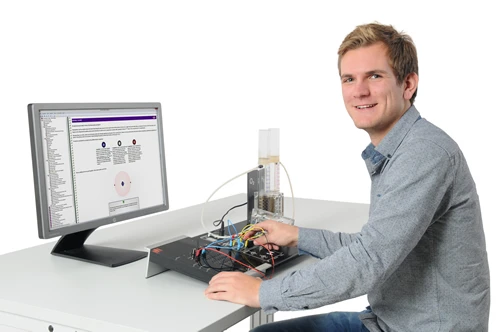
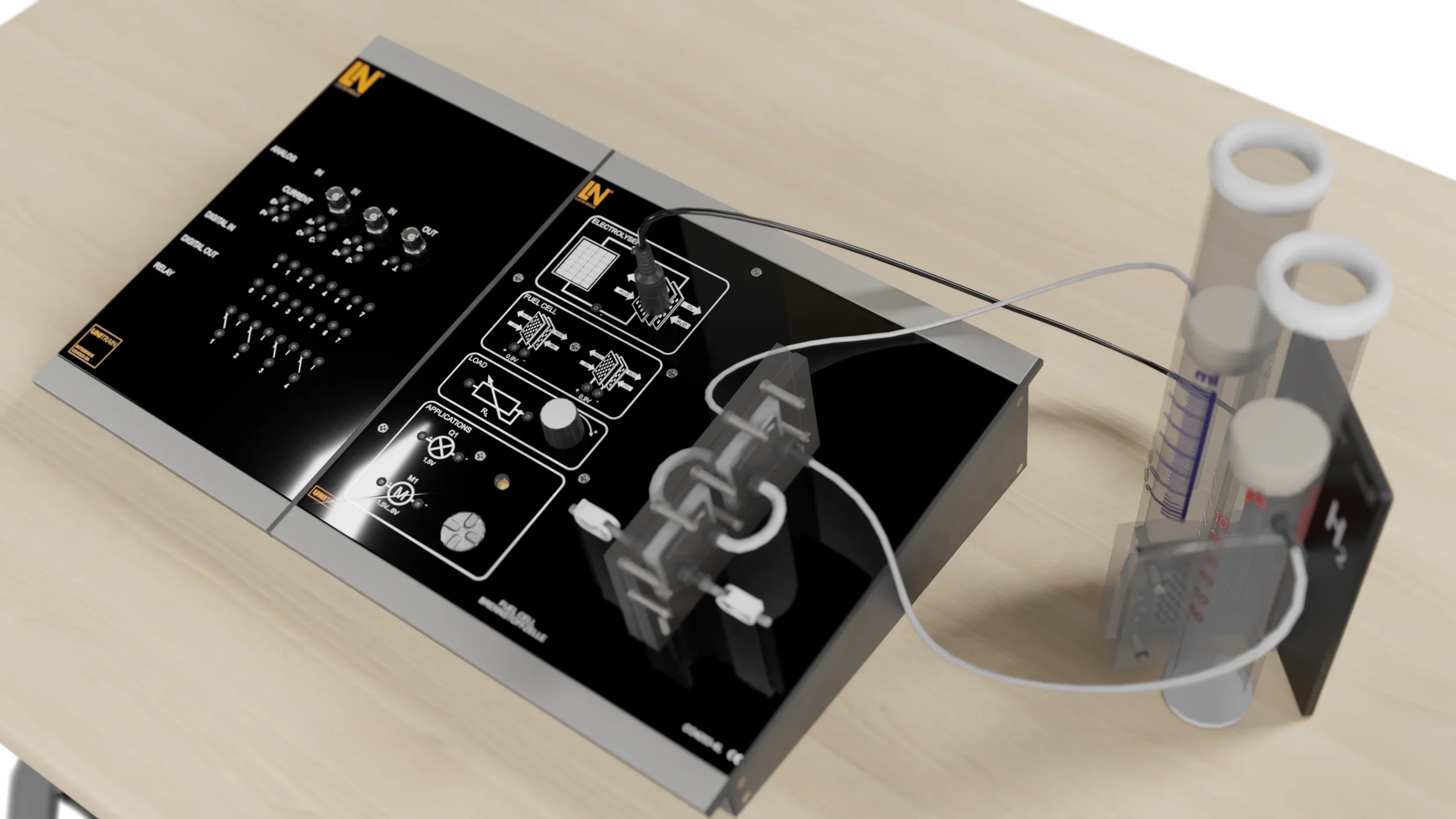
The compact UniTrain system replicates the complete energy conversion cycle: generate hydrogen safely, produce electricity and gain a thorough understanding of the fundamentals of fuel cell technology.

Learning Content
  • Understanding the operating principle of the hydrogen cycle
  • Characterizing components
  • Calculating and evaluating efficiencies
  • Connecting fuel cell stacks
KEY FEATURES
  • Complete hydrogen cycle in one system
  • Quantitative analysis of characteristic curves and efficiencies
  • Investigation of series and parallel circuits
  • Inherently safe system design for risk-free experimentation
Speak with a Product Specialist +1 (757) 808-5696 · sales@lucas-nuelle.com

Hydrogen and fuel cells are key technologies for a CO2-neutral future, in mobility as well as in the storage of renewable energy. Anyone who wants to use them safely must understand the electrochemical processes: from electrolysis to “cold combustion” in the cell. The UniTrain system replicates the complete hydrogen cycle in a benchtop system. Learners use the PEM electrolyzer to produce hydrogen and oxygen, read the gas volumes on the graduated storage tanks and use them to generate electricity again in the PEM double fuel cell. Using the UniTrain interface, they record characteristic curves and determine the decomposition voltage, the maximum power point and the efficiencies. The hydrogen is produced unpressurized and only in the quantity required; no gas cylinders are needed.

CO4204-3CCourse Power engineering: Fuel cell technology
CO4203-2AUniTrain Interface mit virtuellen Instrumenten (Basis VI)
CO4203-2JUniTrain measurement accessories, shunts and connection cables
CO4203-2YUniTrain storage case for one UniTrain system
LM2330Multi13S digital multimeter

Learning Content in Detail

With the UniTrain fuel cell technology system, learners acquire sound professional competence. They develop an in-depth understanding of how hydrogen technology works and of its potential. The practical learning objectives prepare them well for future challenges in the energy sector and strengthen their technical expertise.

Understanding the operating principle of the hydrogen cycle

Learners carry out the process of producing hydrogen by PEM electrolysis and generating electricity in a PEM fuel cell in practice and grasp the electrochemical fundamentals.

Characterizing components

Learners record the U/I characteristics of an electrolyzer and a fuel cell. From these, they determine key parameters such as the decomposition voltage and the maximum power point (MPP).

Calculating and evaluating efficiencies

Learners determine the Faraday efficiency and the energy efficiency by measurement, both for the electrolysis process and for the fuel cell. They analyze the losses in the overall process.

Connecting fuel cell stacks

Learners build series and parallel circuits of fuel cells. They compare their effects on the output voltage, current and total power by measurement.

Learning to handle hydrogen technology safely

Learners understand the system’s safety features and use fuel cell technology safely by understanding how the inherently safe design works.

Applying stoichiometric ratios and Faraday’s laws

Learners verify the stoichiometric ratio of hydrogen and oxygen during electrolysis. They apply Faraday’s laws in practice to calculate the efficiency.

Features & Applications

With the UniTrain fuel cell technology system, you discover practical applications and understand the hydrogen cycle. In the process, you develop technical skills: analyzing characteristic curves, calculating efficiencies and handling this future technology safely.
  • Complete hydrogen cycle in one system — The system demonstrates the complete energy conversion cycle: using a PEM electrolyzer, learners produce hydrogen and oxygen from water, which they then convert into electricity in a PEM fuel cell. The closed cycle makes hydrogen technology tangible and easy to understand.
  • Quantitative analysis of characteristic curves and efficiencies — The UniTrain interface is a multifunctional measuring instrument that records precise characteristic curves (U/I, power) of the electrolyzer and the fuel cell. This enables fundamental parameters such as the decomposition voltage, MPP, Faraday efficiency and energy efficiency to be investigated and calculated quantitatively.
  • Investigation of series and parallel circuits — The experiment board with double fuel cell allows cells to be connected in series and in parallel. Comparing both circuits by measurement teaches learners how fuel cell stacks are designed for higher voltages or currents.
  • Inherently safe system design for risk-free experimentation — Safe hydrogen operation in the lab and classroom, with H2 generated on demand in small quantities for immediate consumption. External high-pressure cylinders are not required. Learners focus on principles instead of complex safety measures.
  • PEM electrolyzer with graduated gas storage tanks — The PEM electrolyzer produces high-purity hydrogen for quantitative analyses. Integrated, graduated gas storage tanks make the H2 and O2 volumes directly measurable. This allows the stoichiometric 2:1 ratio to be verified in practice and the efficiency to be calculated using Faraday’s laws.
  • PEM double fuel cell for stack simulation — Two PEM fuel cells integrated on the board, which can be connected flexibly, illustrate the principle of a “stack” for increasing power. Learners investigate and compare the characteristic curves of a single cell, a series connection (voltage increase) and a parallel connection (current increase).
  • Electrical loads — A variable load resistor, a lamp and a small electric motor are provided on the experiment board. They demonstrate different operating points of the fuel cell and the need to connect cells to form a stack.
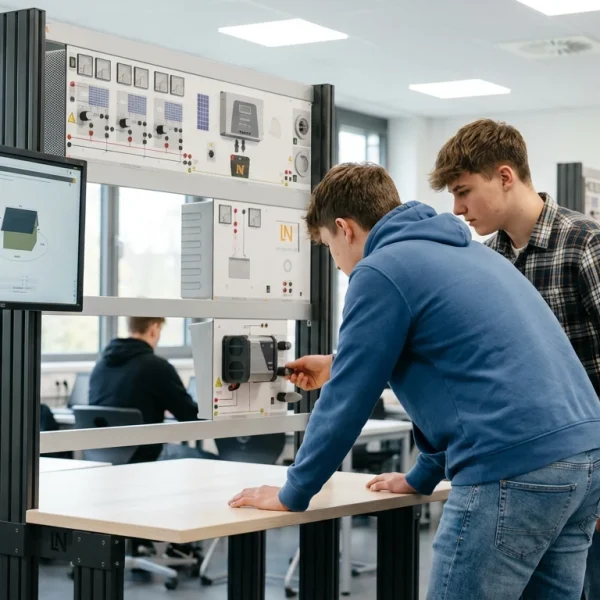
Learners working with RXLea on a tablet at a Lucas-Nuelle training system
RXLea

From Knowledge Comes Capability.

You guide the learning

Where theory and practice go hand in hand.

RXLea brings a new way of learning: project-based, hands-on and clearly structured. Learners solve real-world tasks, while instructors save time on preparation. Interactive modules, smart analytics and real hardware create a modern, efficient learning world.

Hands-on and interactive

Animations, interactive tasks and realistic scenarios build a deep understanding. All content is organized into clear learning paths for focused, hands-on learning.

Digital support

3D assembly animations and digital instructions simplify complex procedures, reduce errors and help learners work more independently.

Visual support

Overview graphics, screenshots and sample animations make the learning world transparent. Photos from the learning packages are also available, including country-specific versions where needed.


Learners using a tablet at an energy training system
RXLea on desktop, laptop and tablet
RXLea Path Creator for building learning journeys
RXLea Navigator showing the learning world
Learn more about RXLea
Newsletter

Stay ahead in
technical training.

Get the latest training systems, product launches and educational insights, delivered directly to your inbox.

Your email address

By subscribing, you agree to our Privacy Policy. You can unsubscribe at any time.

 Please select at least one category before subscribing.
I'm interested in - select all that apply