


Measurement Technology: Non-Electric Values Displacement/Angle/Speed
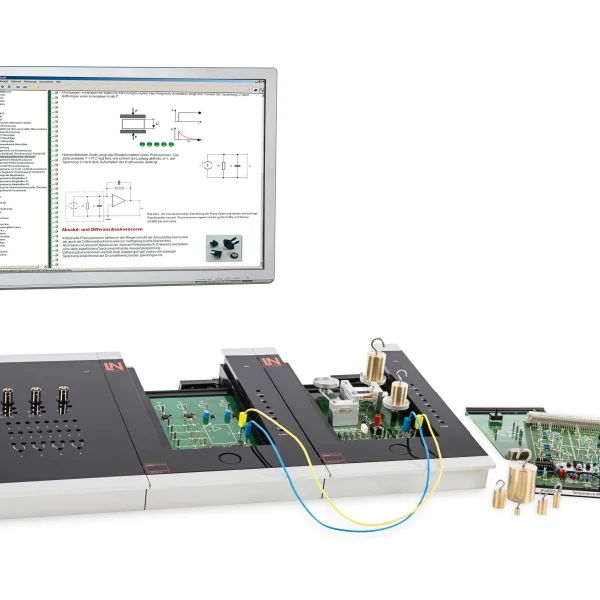
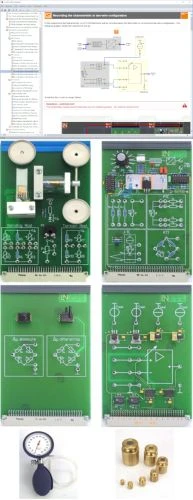
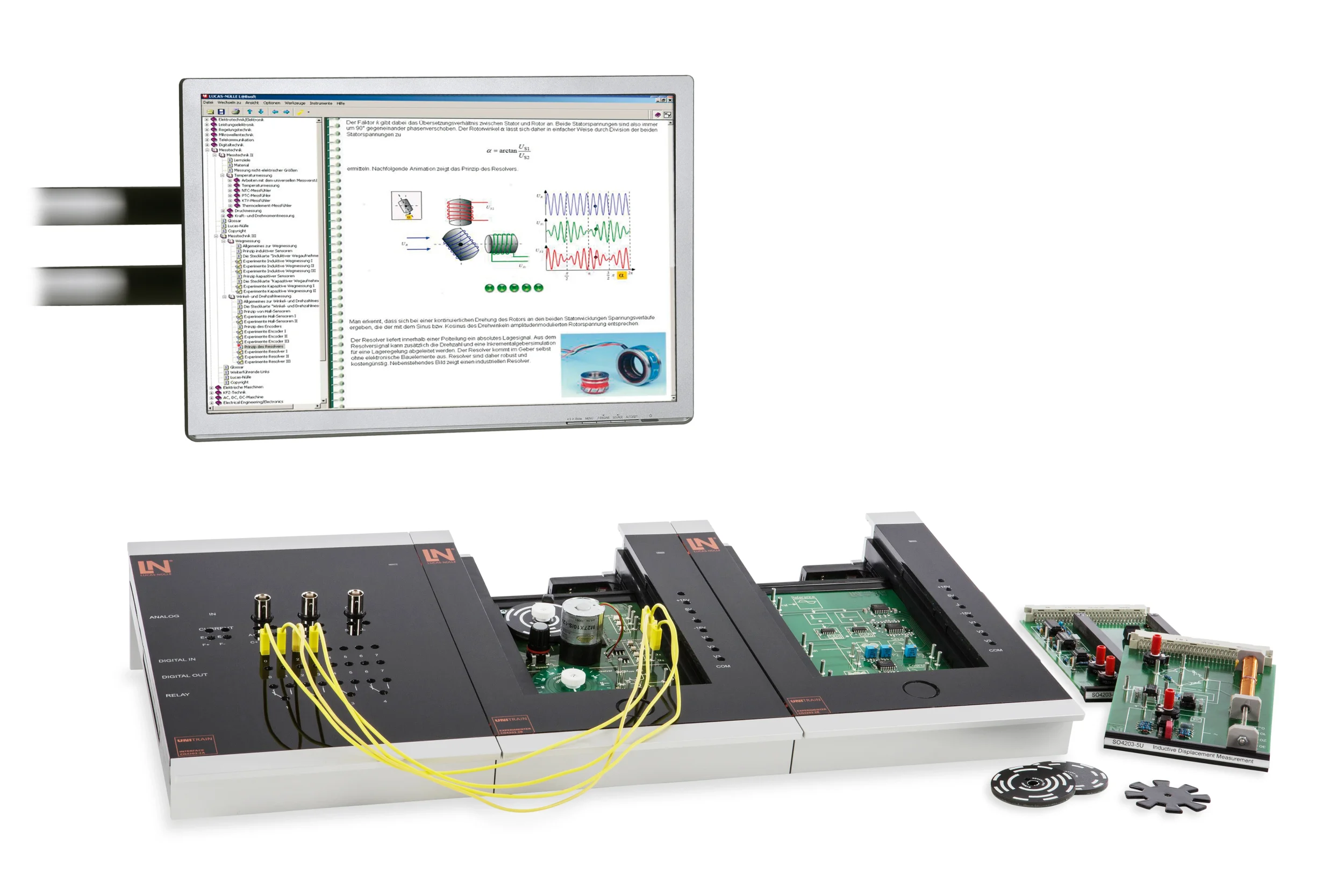
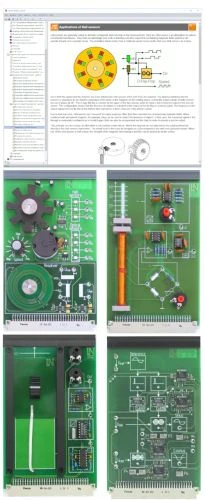
UniTrain training system for displacement, angle and speed measurement: learners investigate inductive, capacitive, optical and magnetic sensors on real cards and evaluate the signals with virtual instruments.
- Balancing an inductive measuring bridge
- Recording static displacement characteristics
- Analyzing capacitive displacement measurement
- Calibrating the f/V converter circuit
- Optics, Hall sensors and resolver on one shaft
- Manual signal conditioning and bridge balancing
- Comparative analysis of code patterns and sensors
- Inductive displacement transducer experiment card
In drive engineering and mechatronics, fast and precise measurement of displacement, angle and speed determines dynamic performance and production quality. Incorrectly recorded measurements or wrongly evaluated encoder signals lead to positioning errors and failures in CNC processes. The training system presents the common sensor principles side by side: a differential inductor with a movable core, a plate capacitor with a sliding mechanism, and a driven shaft with optical scanning, 3-channel Hall sensors and a resolver. Learners balance measuring bridges using trimmers, exchange code discs for binary, Gray and incremental coding, and decode angular positions with the virtual Digital Encoder instrument. Afterwards, they are able to select sensors, condition them and evaluate their signals reliably.
| Base Product | |
| CO4204-8C | Course Measurement technology 3: Non-electric values displacement/angle/speed |
| Measuring Instruments | |
| LM2330 | Multi13S digital multimeter |
| Accessories | |
| CO4203-2A | UniTrain Interface mit virtuellen Instrumenten (Basis VI) |
| CO4203-2J | UniTrain measurement accessories, shunts and connection cables |
| CO4203-2Y | UniTrain storage case for one UniTrain system |
| CO4203-2B | UniTrain Experimenter |
Learning Content in Detail
Balancing an inductive measuring bridge
Recording static displacement characteristics
Analyzing capacitive displacement measurement
Calibrating the f/V converter circuit
Investigating incremental encoders
Evaluating the reference track
Comparing binary and Gray code
Using Hall sensors for commutation
Measuring speed
Conditioning resolver signals
Features & Applications
- Optics, Hall sensors and resolver on one shaft — Optical scanning, 3-phase Hall sensors and a resolver are mounted together on a driven shaft. Learners compare the methods directly on the same motion sequence.
- Manual signal conditioning and bridge balancing — Phase, offset and gain of measuring bridges and resolvers are set using trimmers. Learners carry out the adjustment themselves instead of leaving it to the software.
- Comparative analysis of code patterns and sensors — The interchangeable code discs can be swapped quickly. Learners evaluate binary, Gray and incremental coding based on the errors that actually occur at bit transitions.
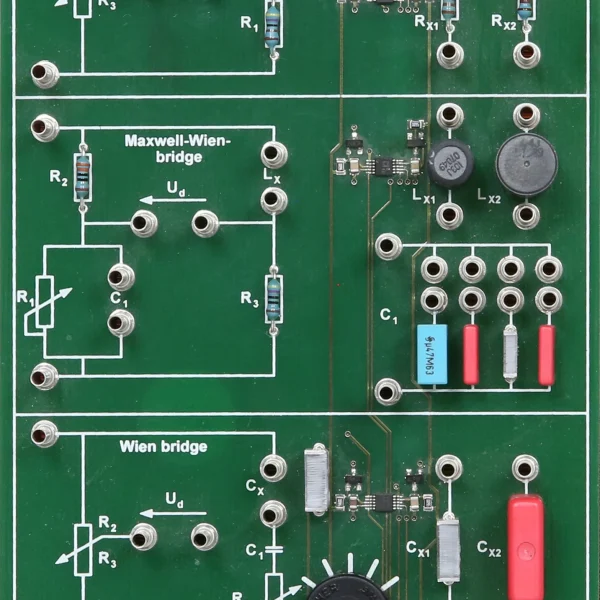
- Inductive displacement transducer experiment card — The card contains a differential inductor with a movable core, an AC measuring bridge, a differential amplifier and a sample-and-hold circuit for linear position measurements.
- Capacitive displacement transducer experiment card — A plate capacitor with a sliding mechanism, an RC oscillator, an f/V converter and a differential amplifier make the change in effective area measurable.
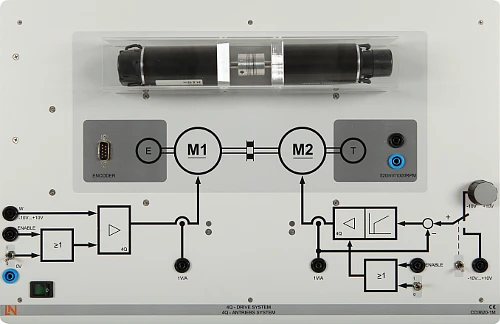
- Angle and speed measurement experiment card — A variable-speed DC drive turns the shaft. Fork light barriers for 4-bit scanning, 3-channel Hall sensors and a transformer-type resolver measure angle and speed.
- Resolver measuring amplifier experiment card — Using multi-turn trimmers, the card converts high-frequency modulated resolver signals into standardized DC voltages from −10 V to +10 V.
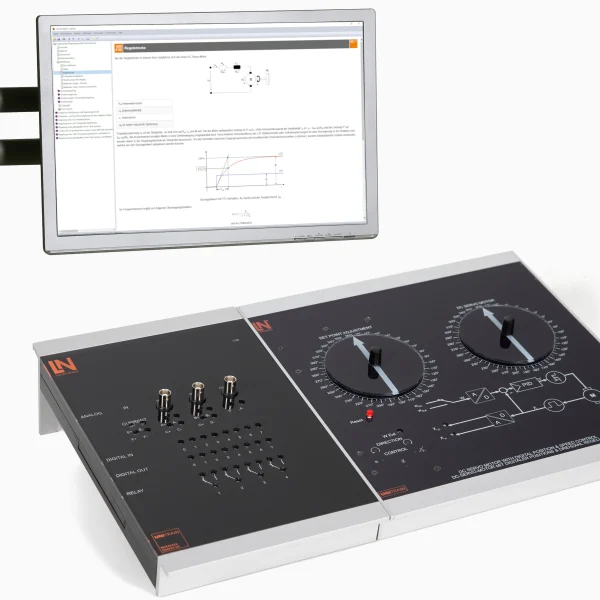
- Virtual oscilloscope — Two channels display the waveforms of current, voltage and instantaneous power over time in X/T mode.
- Waveform generator — The generator produces synthetic and mathematically defined waveforms that can be used to investigate deviations of the meter movements.
- Digital Encoder virtual instrument — The instrument shows the signal states of the 4-bit scanning, decodes the angular position and visualizes direction detection in real time.

From Knowledge Comes Capability.
You guide the learning
Where theory and practice go hand in hand.
RXLea brings a new way of learning: project-based, hands-on and clearly structured. Learners solve real-world tasks, while instructors save time on preparation. Interactive modules, smart analytics and real hardware create a modern, efficient learning world.
Hands-on and interactive
Animations, interactive tasks and realistic scenarios build a deep understanding. All content is organized into clear learning paths for focused, hands-on learning.
Digital support
3D assembly animations and digital instructions simplify complex procedures, reduce errors and help learners work more independently.
Visual support
Overview graphics, screenshots and sample animations make the learning world transparent. Photos from the learning packages are also available, including country-specific versions where needed.




Stay ahead in
technical training.
Get the latest training systems, product launches and educational insights, delivered directly to your inbox.