

Contactor Circuits in Three-Phase Circuits with 24 V DC Control Voltage
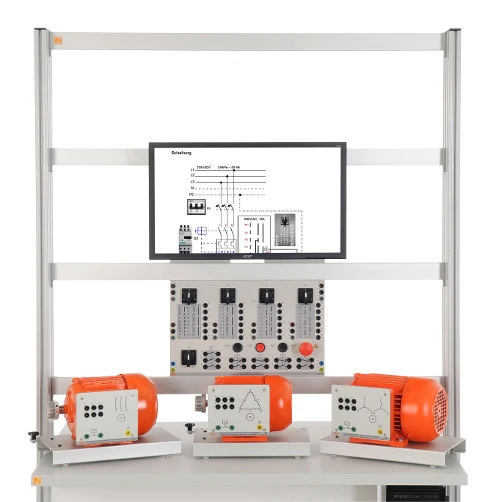
PanelTrain training system for control technology: learners design, wire and test contactor circuits in three-phase circuits with 24 V DC control voltage, from self-holding to pole changing.
- Creating circuit diagrams in compliance with standards
- Dimensioning motor protection
- Wiring self-holding circuits
- Implementing fault signals
- Developing circuit diagrams and wiring contactor controls
- Setting motor protection relays and wiring fault signals
- Interlocking direction reversal safely
- Wye-delta starting, manual and automatic
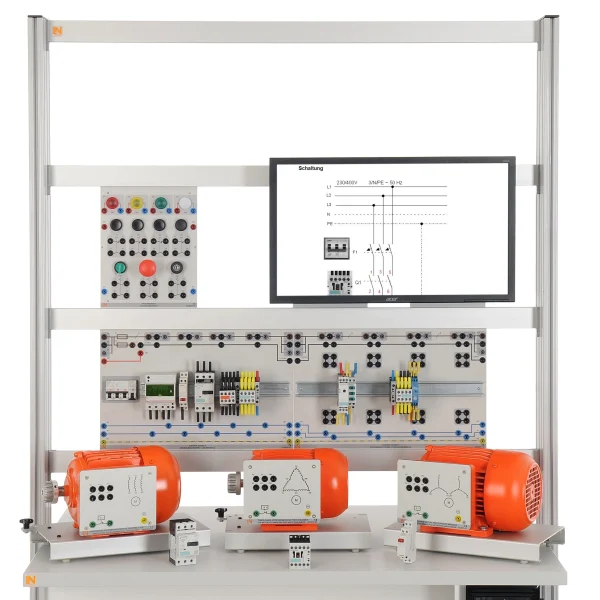
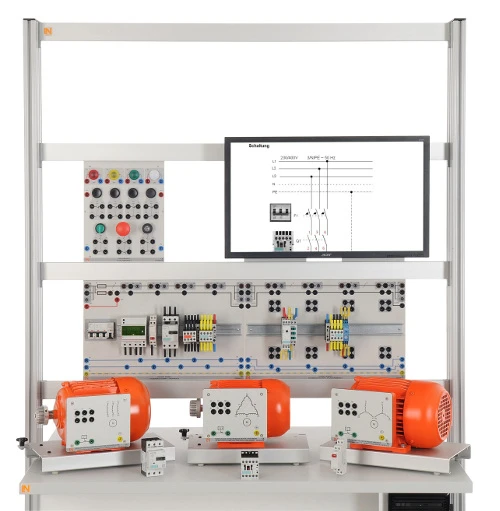
Contactor controls switch electrical drives in industrial plants. Designing, wiring and testing them properly is one of the core competencies of electrical trades. The training system covers the path from simple to complex contactor circuits in three-phase circuits, with a control voltage of 24 V DC. On the basic module with DIN rail, circuit breaker and potential distributor, learners build reversing circuits, wye-delta starters and Dahlander pole-changing circuits. Motor protection relays and fault signaling circuits show how a system reacts in the event of an overload. By the end, learners master the construction, commissioning and troubleshooting of three-phase motor controls.
| Base Product | |
| CO3209-1B | Switches and buttons for contactor controls, 24 V |
| CO3209-1C | Control technology I, Basic module with a feed unit and 2 power circuit breakers |
| SO3209-2D | Control technology I, Equipment set for assembling simple contactor circuits |
| Media | |
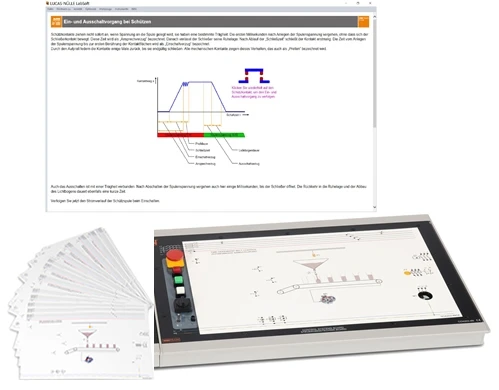
| SO2801-4B | Interactive Lab Assistant Contactor systems for three-phase motors |
| Power Supply | |
| CO3538-8C | Stabilised DC powersupply 24V/6A |
| Accessories | |
| SE2669-1J | 160-piece set of 4mm adapters for control components |
| SE2683-1G | Three-phase asynchronous motor, 0.3 kW n=1400 (400V/690V) |
| SE2682-3K | Three-phase asynchronous motor, Dahlander, 0.3kW |
| SE2682-3L | Three-phase asynchronous motor, two separate windings, 0.3 kW |
| SE2662-2C | Shaft end guard, 0.3kW |
| LM2323 | TRMS digital multimeter MetraHit 2+, CAT III |
| SO5148-1B | Set of safety measurement cables, 4mm (53 leads) |
| CO3209-1G | Control tech. III, supp. module with two rows for assembly of arbitrary circuits |
| CO3212-5V | Three-phase power supply with motor protection switch |
| Furniture | |
| ST7200-7A | SybaPro experiment trolley, 3-level, 6 sockets, 1250x1970x800mm |
| ST8010-4T | Monitor holder for flat screen monitor of weight up to 15kg / 33lbs |
| ST7200-5L | Protection cover for three-level experiment trolleys |
Learning Content in Detail
Creating circuit diagrams in compliance with standards
Dimensioning motor protection
Wiring self-holding circuits
Implementing fault signals
Commissioning timing functions
Building impulse controls
Interlocking reversing circuits
Implementing end-position shutdown
Comparing starting circuits
Switching speed stages
Features & Applications
- Developing circuit diagrams and wiring contactor controls — Learners develop circuit diagrams and then use them to build contactor controls for three-phase motors independently. They progress from basic to advanced circuits.
- Setting motor protection relays and wiring fault signals — Learners set the motor protection relay precisely and wire simple and latched fault signals for the overload case.
- Interlocking direction reversal safely — Reversing contactor controls with contactor and push-button interlocking show how drives can be reversed without causing a phase-to-phase short circuit.
- Wye-delta starting, manual and automatic — Learners analyze the starting behavior of three-phase motors and implement wye-delta reversing circuits, either manually or controlled by timing relays.
- Speed changeover of induction motors — The equipment allows learners to build Dahlander pole-changing circuits as well as controls for motors with two separate windings.
- Limit control with mechanical limit switches — Mechanical limit switches enable automatic end-position shutdown with reversal of the direction of rotation, as found in gate systems.
- Touch-protected industrial components — All components use standardized 4 mm safety jacks and touch-protected adapters. This keeps experimenting on the setup free of danger.
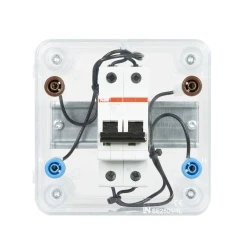
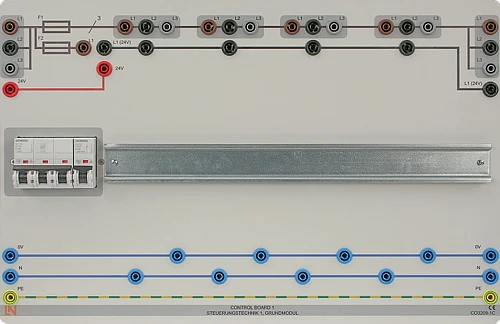
- Control technology basic module with power supply — The basic module serves as a mounting platform with DIN rail and contains a circuit breaker, potential distributor and a main voltage bus.
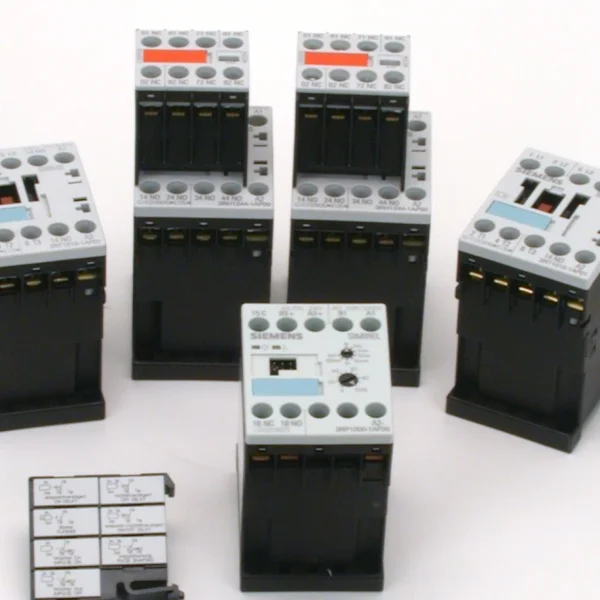
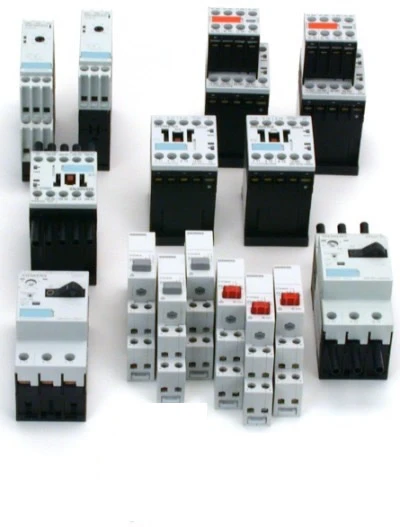
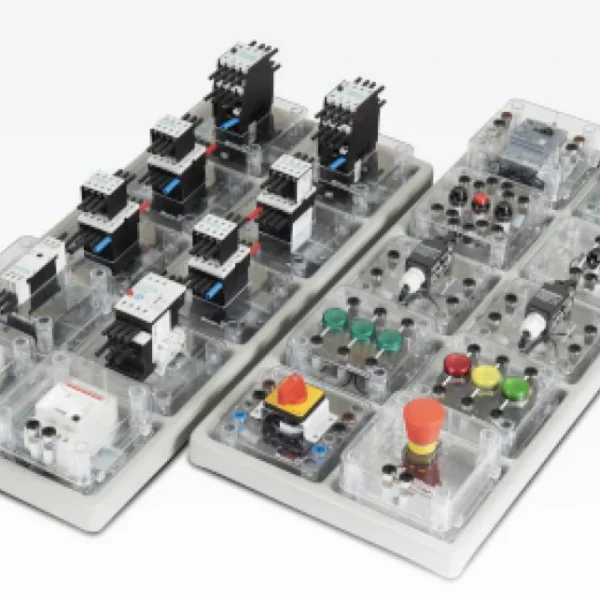
- Device set with main and auxiliary contactors — The device set comprises four four-pole main contactors, auxiliary contactors, auxiliary switch blocks and adjustable motor protection switches.
- Timing relays, on-delay and off-delay — The timing relays can be set from 1.5 to 30 s and enable time-controlled sequences such as automatic wye-delta changeover.
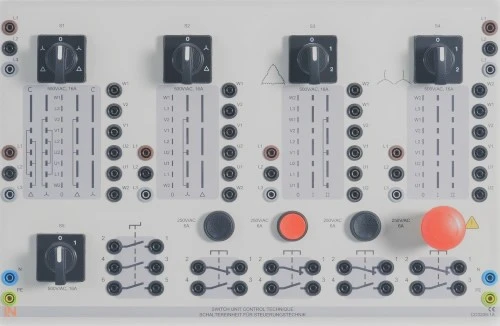
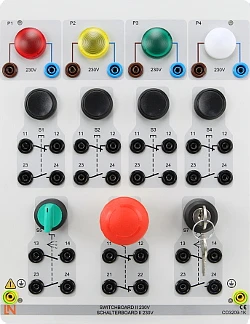
- Switch and push-button unit with signaling devices — The module features an emergency stop button, a manual/automatic switch, control push-buttons and indicator lights in four colors to display the status.
- Impulse switch for impulse controls — The integrated impulse switch enables impulse contactor circuits in which a single push-button changes the switching state.
- 4 mm safety adapter system — Color-coded fork and pin adapters provide a clear connection between standard commercial switching devices and the 4 mm safety jacks.
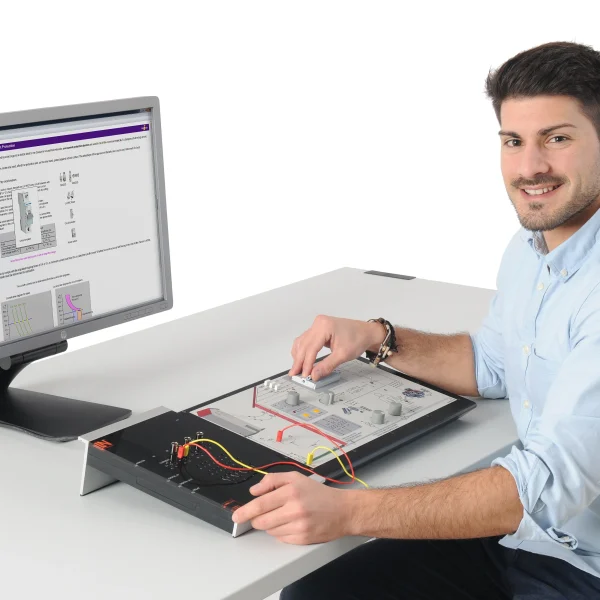
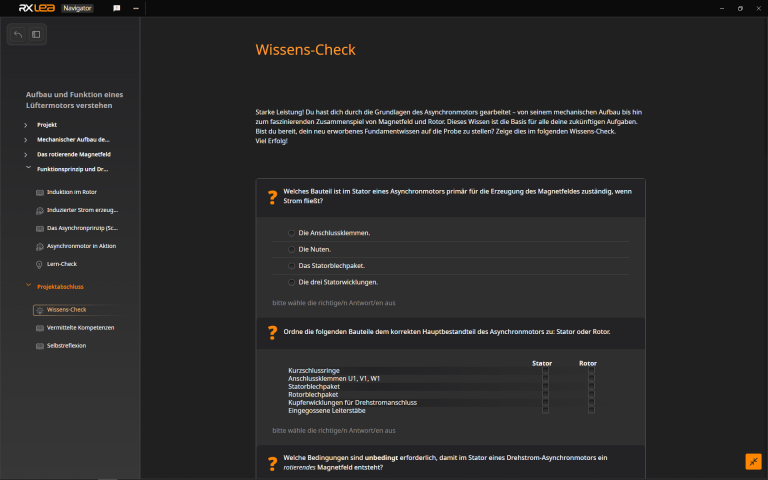
- Interactive LabSoft course on contactor control — The digital course guides learners step by step through circuit design and the real experiments, and includes interactive knowledge tests on the theory.

From Knowledge Comes Capability.
You guide the learning
Where theory and practice go hand in hand.
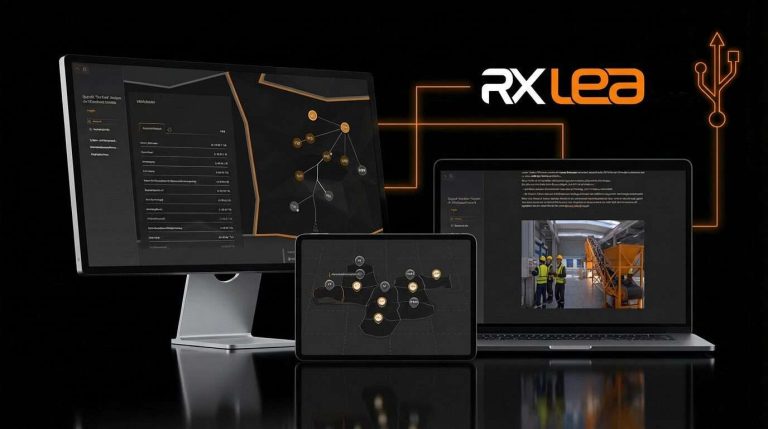
RXLea brings a new way of learning: project-based, hands-on and clearly structured. Learners solve real-world tasks, while instructors save time on preparation. Interactive modules, smart analytics and real hardware create a modern, efficient learning world.
Hands-on and interactive
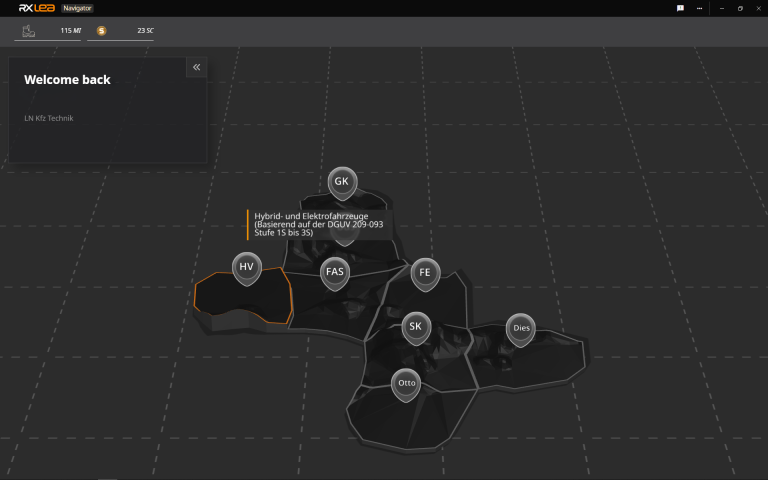
Animations, interactive tasks and realistic scenarios build a deep understanding. All content is organized into clear learning paths for focused, hands-on learning.
Digital support
3D assembly animations and digital instructions simplify complex procedures, reduce errors and help learners work more independently.
Visual support
Overview graphics, screenshots and sample animations make the learning world transparent. Photos from the learning packages are also available, including country-specific versions where needed.

Stay ahead in
technical training.
Get the latest training systems, product launches and educational insights, delivered directly to your inbox.