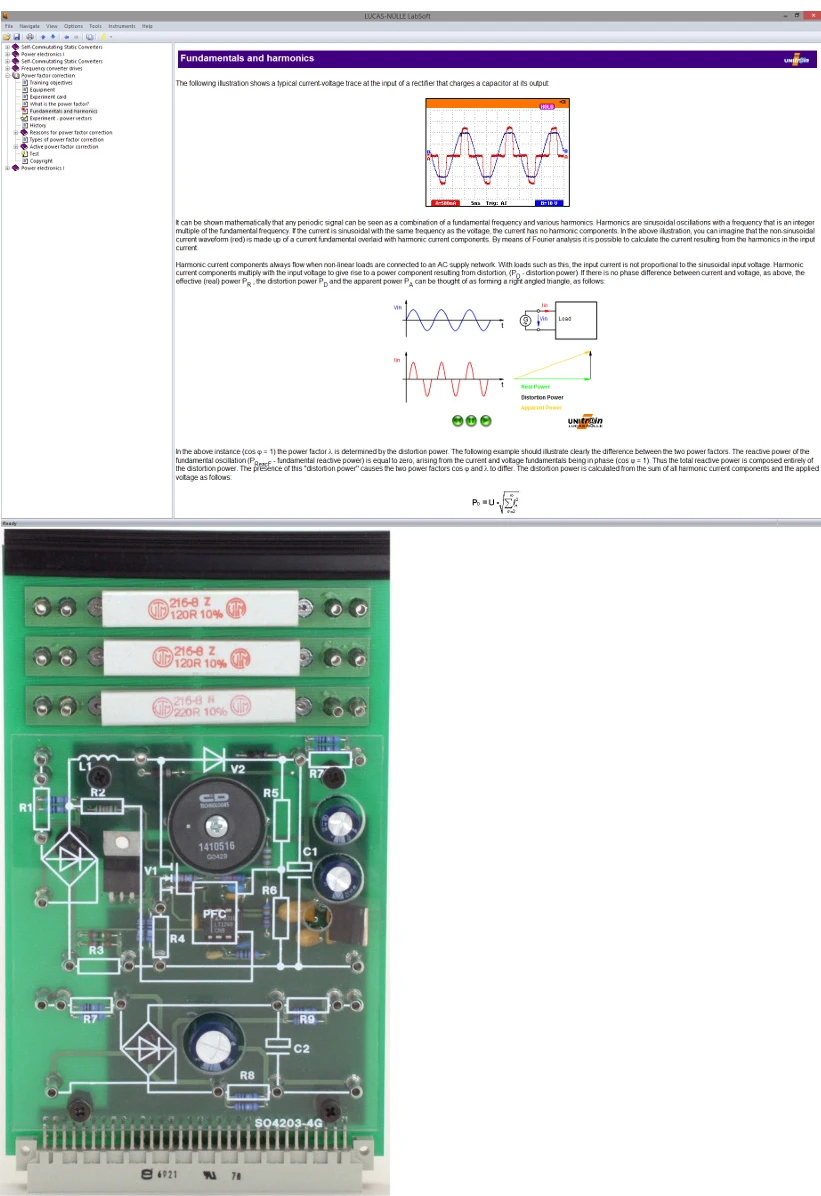



Active Power Factor Correction PFC
A UniTrain course on active PFC: learners compare the B2 bridge with a boost converter switching at 100 kHz, shape the input current sinusoidally and evaluate harmonics and power factor using FFT.
- Analyzing the PFC principle
- Optimizing current draw
- Evaluating the power balance
- Dual topology design for direct comparison
- Integrated loads for dynamic load changes
- High-frequency PFC control electronics
- Safe experimenting at safety extra-low voltage
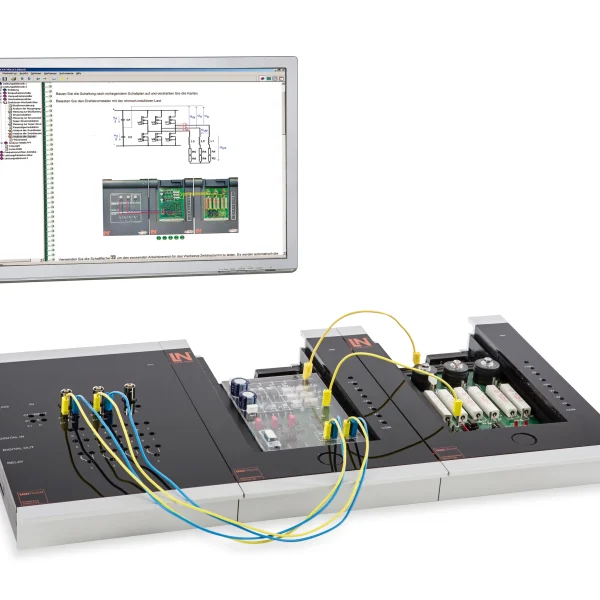
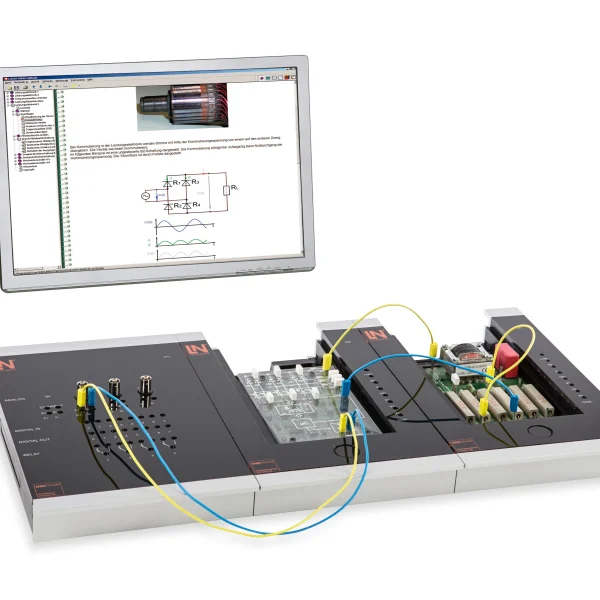
Complex loads do not draw a sinusoidal current from the grid. The resulting harmonics increase the reactive power and place a burden on the supply grid; standard limits have been set for devices in this respect. The UniTrain course shows how active power factor correction counteracts this. The B2 bridge, storage inductor and MOSFET switch are located on one card, allowing learners to compare uncontrolled rectification and the PFC stage directly without any rewiring. They connect integrated load resistors, check control stability during load changes and optimize the cascaded control system. Using the real-time FFT tool, they break the current down into its harmonic components, determine the distortion factor and calculate the power factor. This makes visible what active current shaping achieves in the grid.
| Artikel-Nr. | Menge | Bezeichnung |
|---|---|---|
| Base Product | ||
| CO4204-7Q | 1 | Course Power electronics 4: Active power factor correction PFC |
| Accessories | ||
| CO4203-2A | 1 | UniTrain Interface mit virtuellen Instrumenten (Basis VI) |
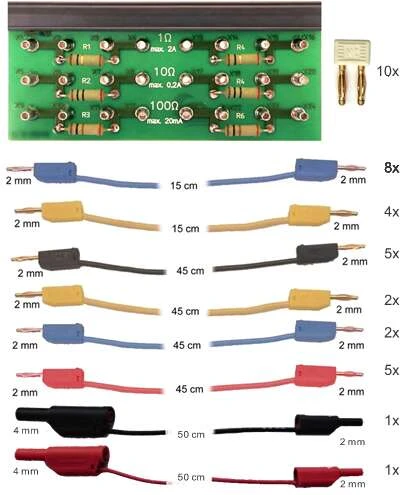
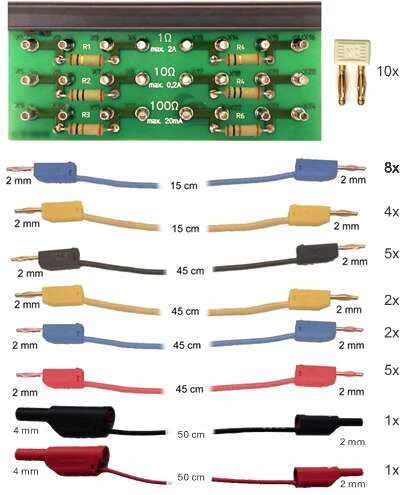
| CO4203-2J | 1 | UniTrain measurement accessories, shunts and connection cables |
| CO4203-2Y | 1 | UniTrain storage case for one system |
| CO4203-2B | 1 | UniTrain Experimenter |
Learning Content in Detail
Analyzing the PFC principle
Optimizing current draw
Evaluating the power balance
Features & Applications
- Dual topology design for direct comparison — A single card holds the B2 bridge and the PFC stage. Learners measure the power factor of both topologies against each other as a reference, without modifying the circuit.
- Integrated loads for dynamic load changes — Switchable high-power resistors are part of the hardware. Learners carry out dynamic load changes and investigate control stability without external components.
- High-frequency PFC control electronics — The module contains a real boost converter switching at 100 kHz. Learners analyze the current waveform and energy storage directly on the circuit.
- Safe experimenting at safety extra-low voltage — All the power electronics work at safety extra-low voltage. Learners handle power semiconductors without risk and can concentrate on signal analysis.
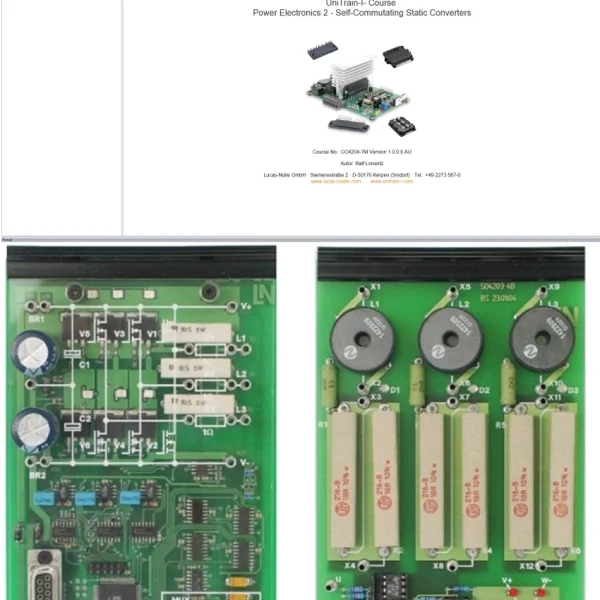
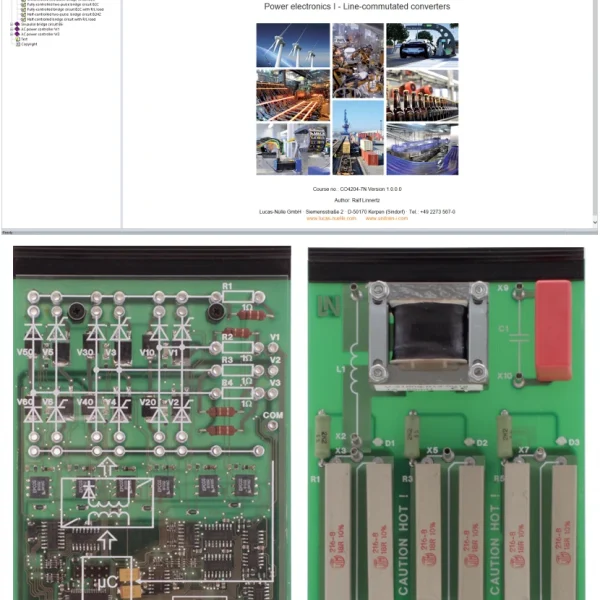
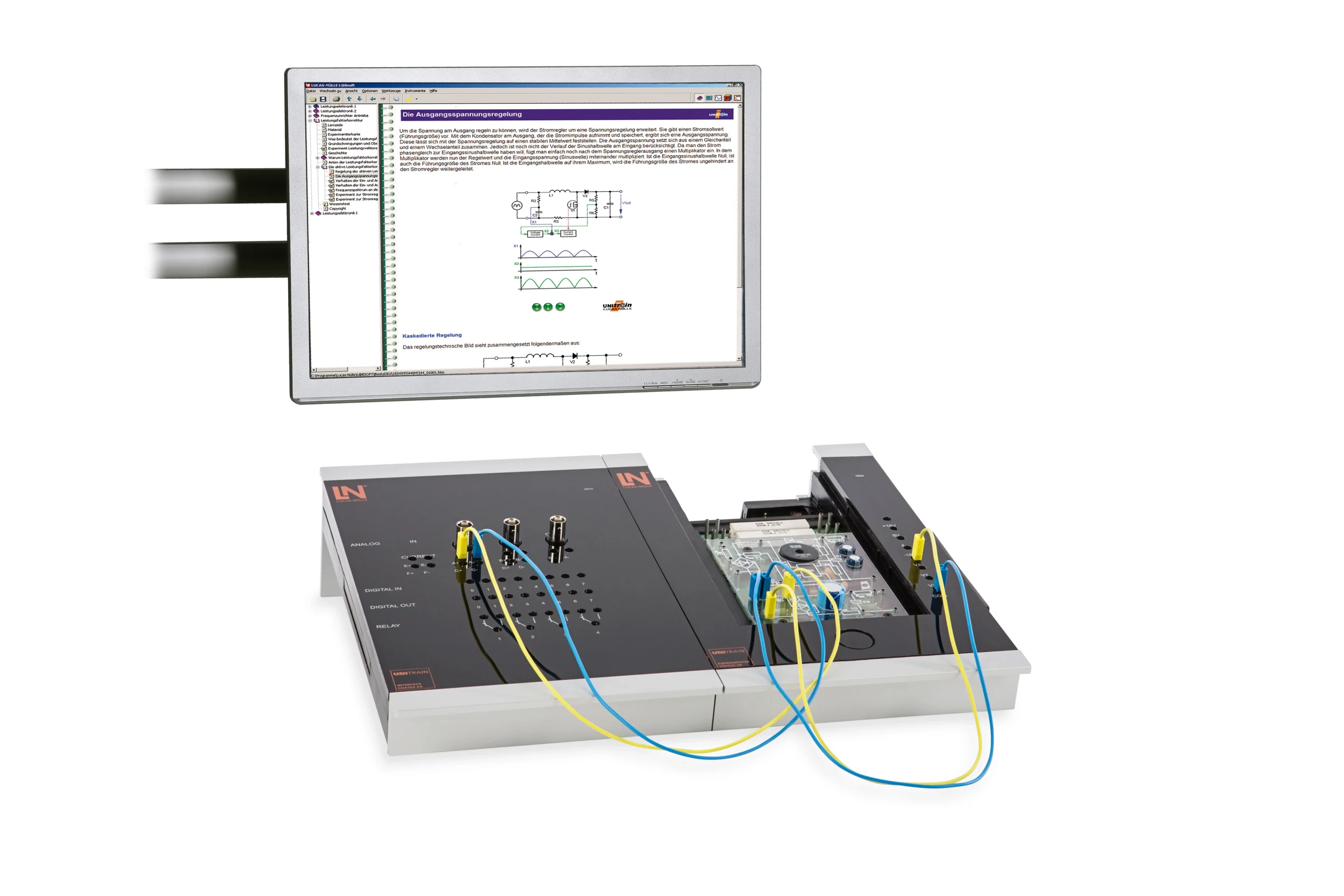
- Active power factor correction experiment card — The card combines the B2 bridge, storage inductor and MOSFET switch. All relevant potentials are accessible via 2 mm jacks and can be picked up with the oscilloscope.
- Integrated load resistors — Two thermally stable resistors serve as the experimental load. Learners connect them in series or in parallel and check the behavior at different current levels.
- Precision shunt module — The current can be recorded directly or measured via the shunt module, so that learners can display current waveforms on the oscilloscope.
- LabSoft digital learning environment — The software combines theory and experiment: learners read instructions, answer interactive tests and save their measurement results directly in the HTML interface.
- Virtual PFC analyzer — Learners control the hardware parameters interactively, use digital filters to analyze signal peaks and make the effect of active current shaping visible.
- Real-time FFT tool — The software breaks the measured signals down into their harmonic components. Learners evaluate the total harmonic distortion (THD) and check compliance with industrial standard limits.

From Knowledge Comes Capability.
You guide the learning
Where theory and practice go hand in hand.
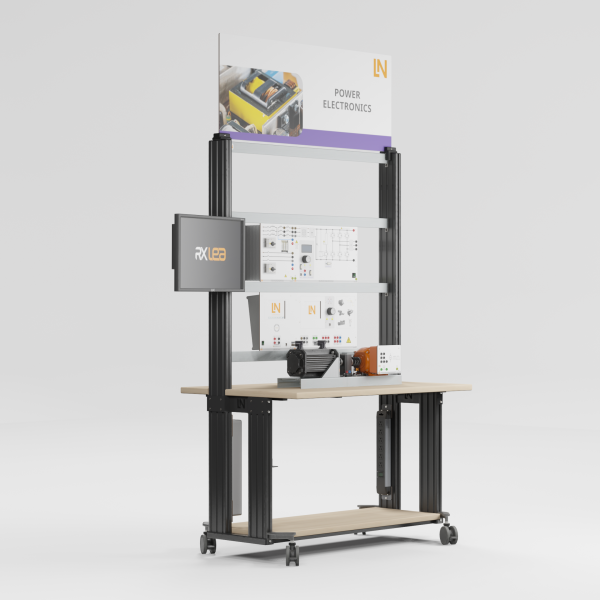
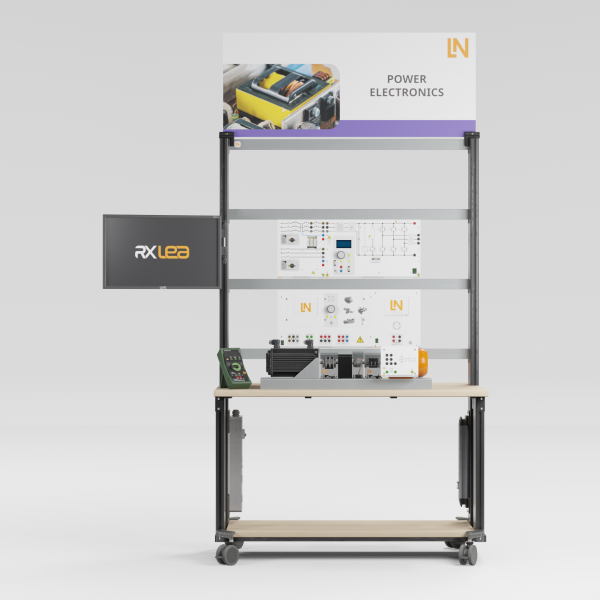
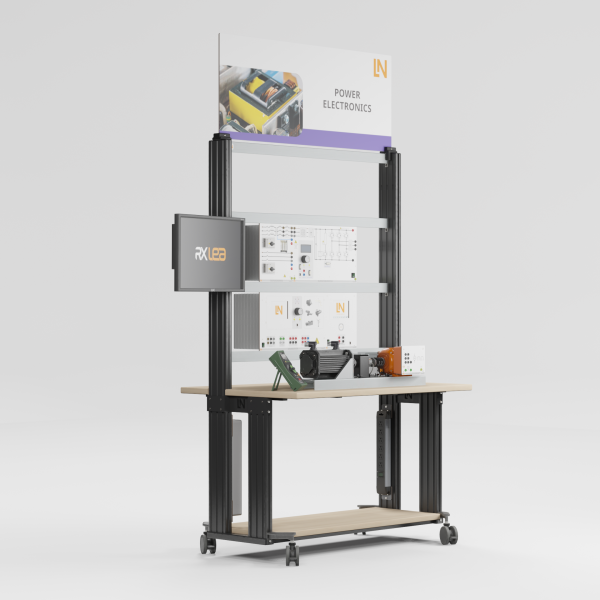
RXLea brings a new way of learning: project-based, hands-on and clearly structured. Learners solve real-world tasks, while instructors save time on preparation. Interactive modules, smart analytics and real hardware create a modern, efficient learning world.
Hands-on and interactive
Animations, interactive tasks and realistic scenarios build a deep understanding. All content is organized into clear learning paths for focused, hands-on learning.
Digital support
3D assembly animations and digital instructions simplify complex procedures, reduce errors and help learners work more independently.
Visual support
Overview graphics, screenshots and sample animations make the learning world transparent. Photos from the learning packages are also available, including country-specific versions where needed.




Stay ahead in
technical training.
Get the latest training systems, product launches and educational insights, delivered directly to your inbox.