


Advanced Fuel Cell Technology
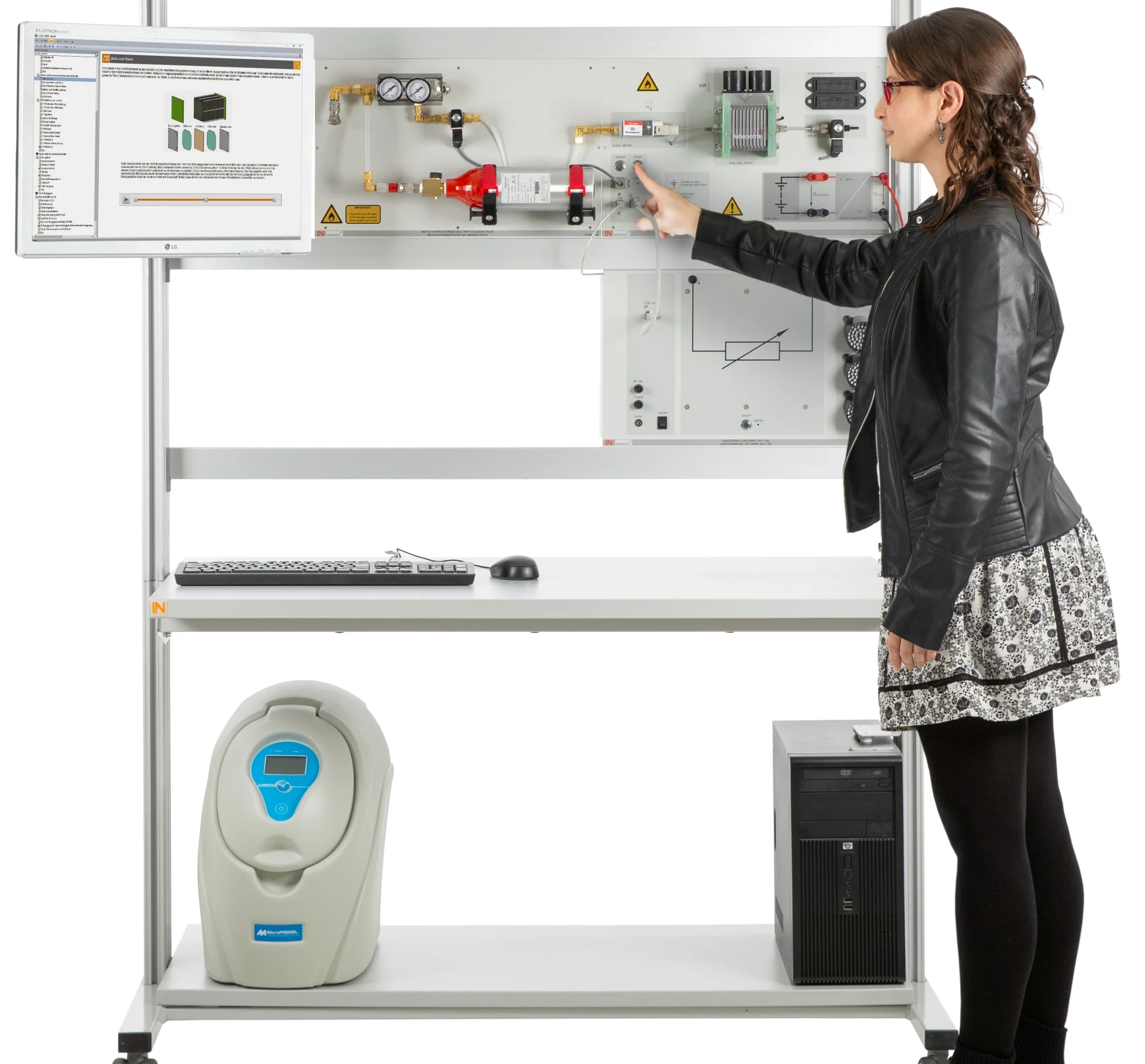
Modular panel system with a 10-cell fuel cell stack and metal hydride storage. Learners record characteristic curves, calculate efficiencies and power a traffic light system in stand-alone operation.
- Investigating the design and function of the components
- Recording characteristic curves on the fuel cell stack
- Calculating efficiencies
- Evaluating factors influencing performance
- Working safely with hydrogen in the laboratory
- Tool-free mounting of the experiment panels
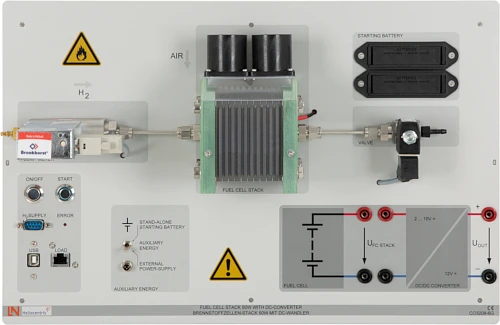
- Fuel cell with DC converter (CO3208-6G)
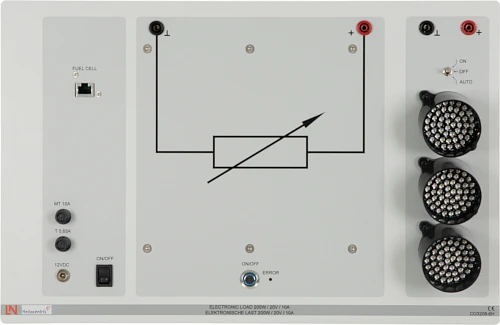
- 200 W electronic load (CO3208-6H)
Hydrogen drives and decentralized power supplies are becoming increasingly important in automotive and energy technology. Anyone who designs or operates them needs a solid foundation in electrochemical energy conversion, thermodynamics, Faraday’s laws and electrolysis. The training system combines real experiment panels with interactive course software. Learners use the electrolyzer to produce high-purity hydrogen, fill the metal hydride storage unit with it and supply a stack with a rated power of 40 W. Using the electronic load, they record characteristic curves, calculate efficiencies and investigate how stack temperature and oxygen supply affect performance. Finally, they dimension fuel cell systems and storage for specific application scenarios.
| Base Product | |
| CO3208-6G | Fuel cell (PEM type) with DC converter |
| CO3208-6H | Electronic load 200W/20V/10A |
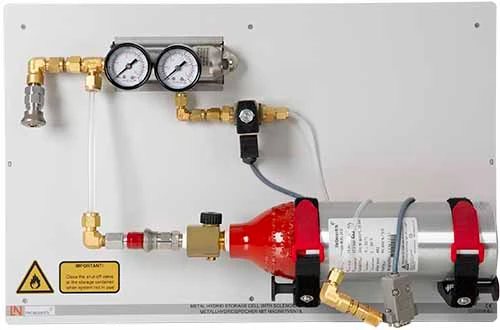
| CO3208-6J | Metal hydride storage cell with solenoid valve |
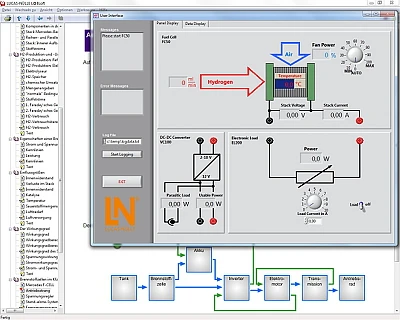
| SO2800-6B | Interactive Lab Assistant: Fuel cell technology - Advanced course |
| Accessories | |
| CO3208-6D | Electrolyser, 30 Normlitre/hour (1.06 cubic feet/h, 7.93 gallons/h, 30000 cc/h) |
| Furniture | |
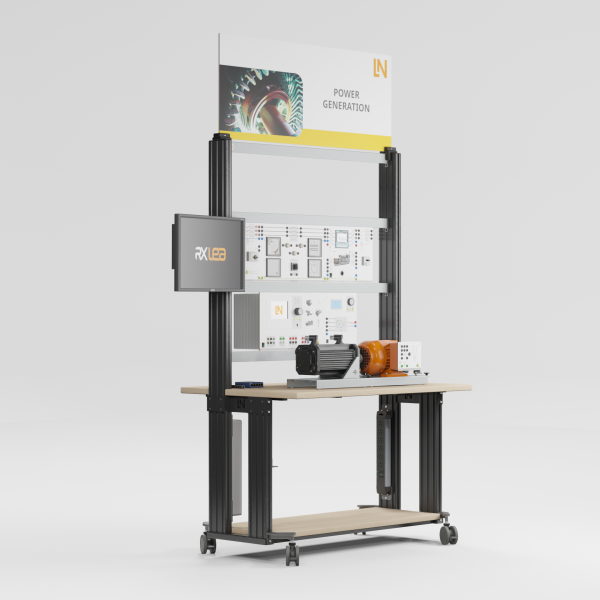
| ST7200-7A | SybaPro experiment trolley, 3-level, 6 sockets, 1250x1970x800mm |
| ST8010-4T | Monitor holder for flat screen monitor of weight up to 15kg / 33lbs |
| ST7200-5L | Protection cover for three-level experiment trolleys |
| ST8010-4G | Keyboard adapter for flat screen monitor holders |
| Furniture Accessories | |
| ST8000-4Q | Display for Hydrogen equipment |
| Measurement Leads | |
| SO5126-3R | Safety connecting plug 4mm with tap (2x), black, 1000V/32A CAT II |
| SO5126-8K | Safety measurement cable 4mm, 50cm/20", red, 600 V CAT III ~1000V, CAT II / 32 A |
| SO5126-8L | Safety measurement cable 4mm, 50cm/20", black, 600V CAT III ~1000V CAT II / 32A |
Learning Content in Detail
Investigating the design and function of the components
Recording characteristic curves on the fuel cell stack
Calculating efficiencies
Evaluating factors influencing performance
Calculating hydrogen consumption
Dimensioning fuel cell systems
Features & Applications
- Working safely with hydrogen in the laboratory — Touch-safe experiment panels and metal hydride storage units hold the hydrogen at low pressure, keeping laboratory operation safe.
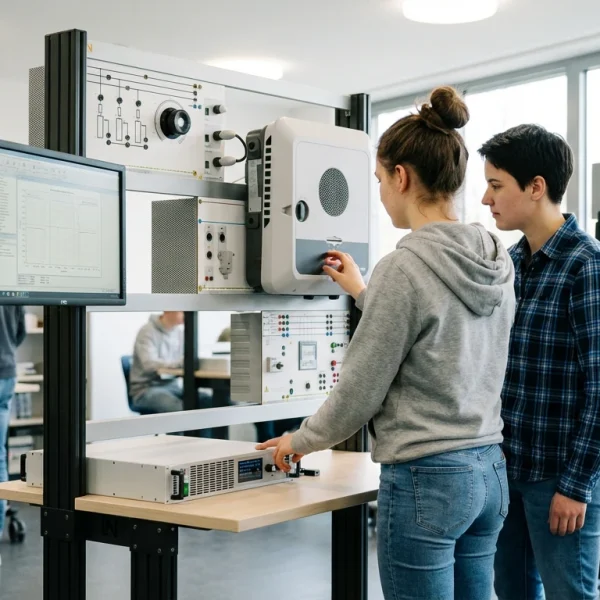
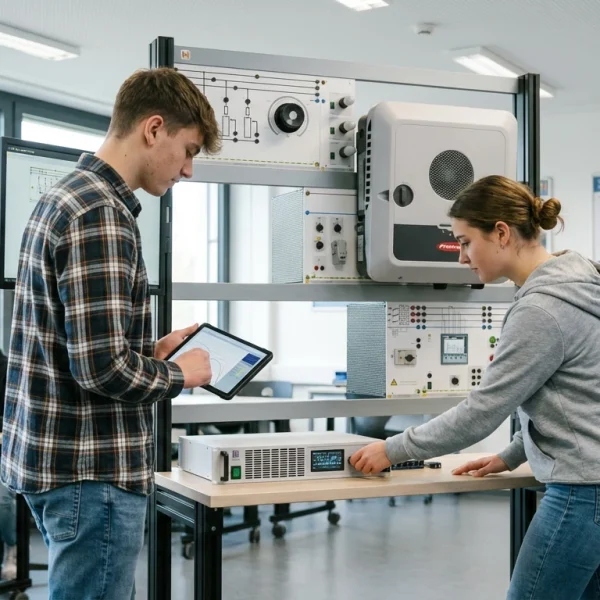
- Tool-free mounting of the experiment panels — Learners insert the standardized A4 panels into the frame without tools. Gas and electrical lines are connected quickly and safely.
- Fuel cell with DC converter (CO3208-6G) — A 10-cell stack with a rated power of 40 W delivers a stable output voltage of 12 V via the DC-DC converter.
- 200 W electronic load (CO3208-6H) — The load operates in constant-current mode up to 10 A. An integrated traffic light circuit serves as a real 12 V consumer.
- Metal hydride storage unit with solenoid valve (CO3208-6J) — The storage unit reversibly absorbs gaseous hydrogen at low pressure and supplies the stack via a solenoid valve.
- Electrolyzer as hydrogen generator (CO3208-6F) — The generator produces grade 6.0 hydrogen at 15.6 standard liters per hour and uses it to fill the storage unit.
- Fuel Cell Control Software — The software records the measured values on the PC. Learners control the load current and fan speed manually and observe the effect on the power output.

From Knowledge Comes Capability.
You guide the learning
Where theory and practice go hand in hand.
RXLea brings a new way of learning: project-based, hands-on and clearly structured. Learners solve real-world tasks, while instructors save time on preparation. Interactive modules, smart analytics and real hardware create a modern, efficient learning world.
Hands-on and interactive
Animations, interactive tasks and realistic scenarios build a deep understanding. All content is organized into clear learning paths for focused, hands-on learning.
Digital support
3D assembly animations and digital instructions simplify complex procedures, reduce errors and help learners work more independently.
Visual support
Overview graphics, screenshots and sample animations make the learning world transparent. Photos from the learning packages are also available, including country-specific versions where needed.




Stay ahead in
technical training.
Get the latest training systems, product launches and educational insights, delivered directly to your inbox.