


Measurement Technology: Electric Values V/I/P/Cos-Phi/F
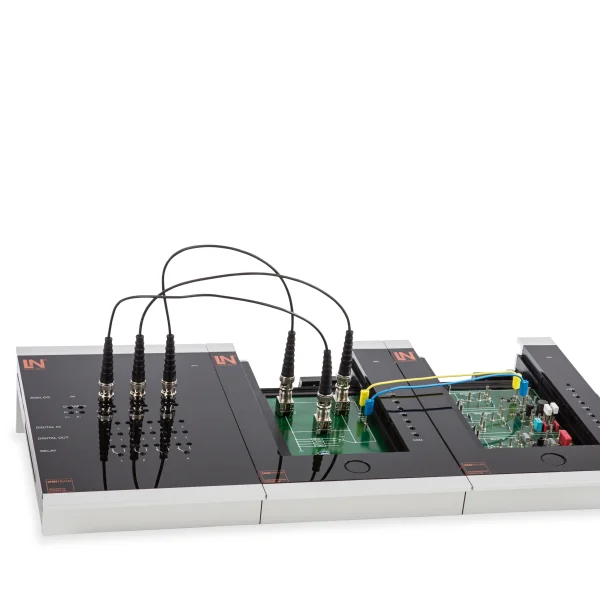
Compact UniTrain training system covering analog and digital measurement methods: learners investigate meter movements, extend measuring ranges and measure active, apparent and reactive power as well as energy and frequency.
- Distinguishing types of meter movement
- Extending measuring ranges
- Compensating circuit errors
- Determining AC power quantities
- Analog meter movements compared
- Extending measuring ranges
- Power analysis with phasor diagrams
- Digital frequency counting
Accurate measurement of current, voltage and active, apparent and reactive power is the foundation of safe power distribution and automated processes. The training system leads there step by step: learners compare moving-coil, moving-iron and electrodynamic meter movements with DC and AC quantities, calculate series resistors and shunts for extending measuring ranges and plug in the corresponding circuits themselves. Using R, L and C test objects, they measure the power quantities and read off the power factor. Digital frequency measurement up to 99 Hz demonstrates gate control, Schmitt trigger pulse shaping and counting uncertainty. A protective circuit guards the meter movements against overvoltage.
| Artikel-Nr. | Menge | Bezeichnung |
|---|---|---|
| Base Product | ||
| CO4204-8A | 1 | Course Measurement technology 1: Electric values V/I/P/cos-phi/f |
| Measuring Instruments | ||
| LM2330 | 1 | Multi13S digital multimeter |
| Options | ||
| SO4203-2Y | 1 | UniTrain storage case for one systemoptional |
| Accessories | ||
| CO4203-2A | 1 | UniTrain Interface mit virtuellen Instrumenten (Basis VI) |
| CO4203-2J | 1 | UniTrain measurement accessories, shunts and connection cables |
| CO4203-2Y | 1 | UniTrain storage case for one system |
| CO4203-2B | 2 | UniTrain Experimenter |
Learning Content in Detail
Distinguishing types of meter movement
Extending measuring ranges
Compensating circuit errors
Determining AC power quantities
Determining the power factor
Measuring electrical energy
Measuring frequency digitally
Features & Applications
- Analog meter movements compared — Learners investigate the behavior of moving-coil, moving-iron and electrodynamic meter movements with real DC and AC quantities.
- Extending measuring ranges — Learners calculate series resistors and shunts and connect them to extend voltage and current measuring ranges as required.
- Power analysis with phasor diagrams — Using resistive, inductive and capacitive test objects, learners measure active, apparent and reactive power and place the values in a phasor diagram.
- Digital frequency counting — Learners investigate gate control, Schmitt trigger pulse shaping and counting uncertainties in frequency measurements up to 99 Hz.
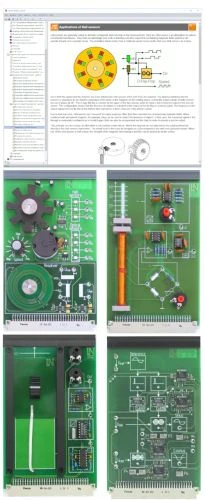
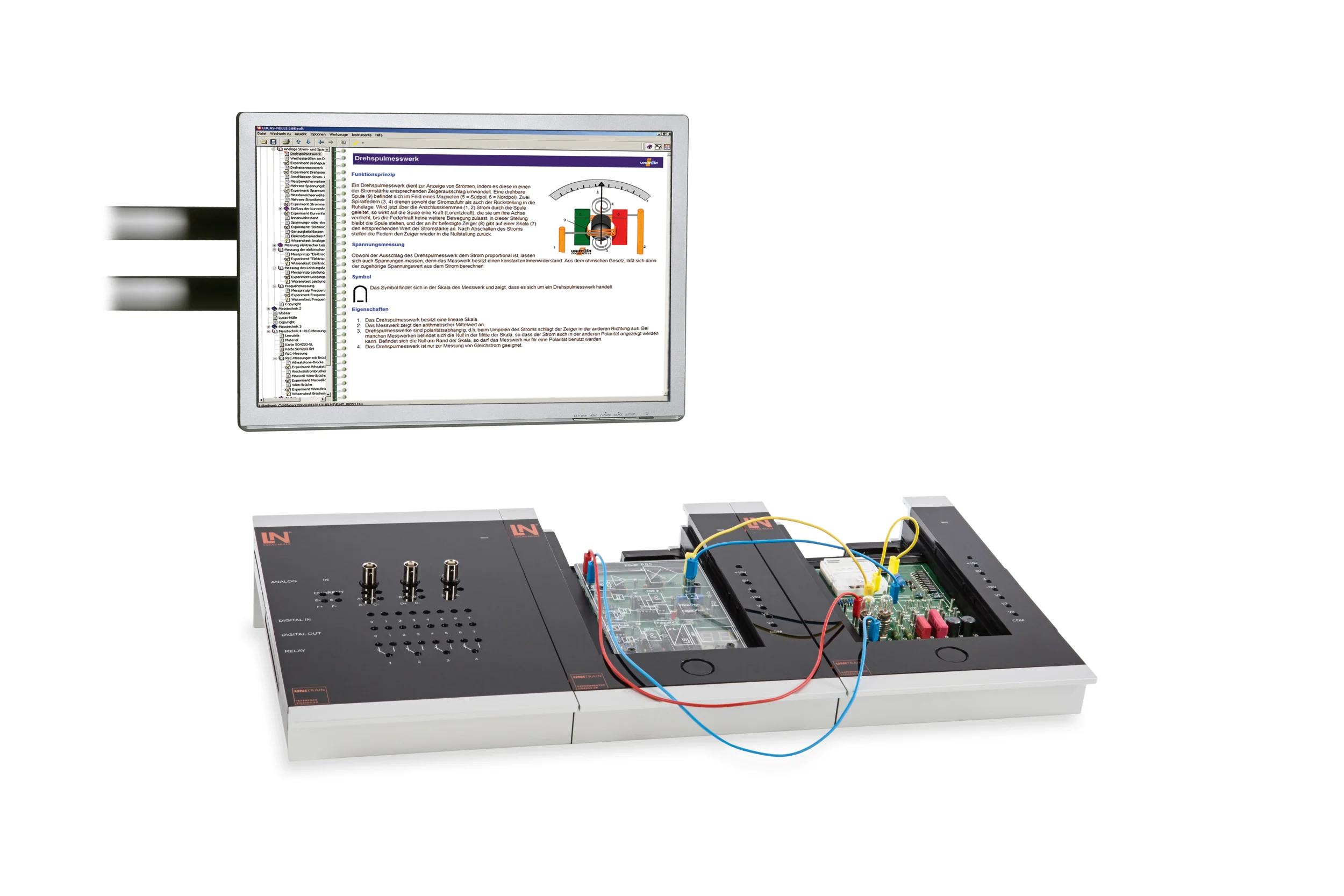
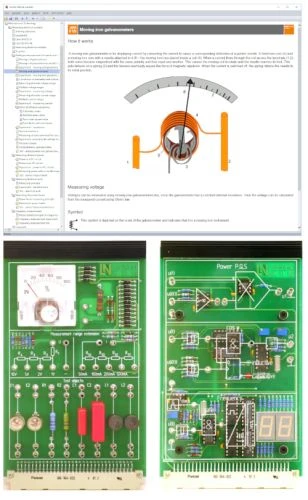
- Moving-coil meter movement with core magnet — The analog meter movement has a linear scale and serves as the analog measuring instrument in the experiments on current, voltage, power and cos φ measurement.
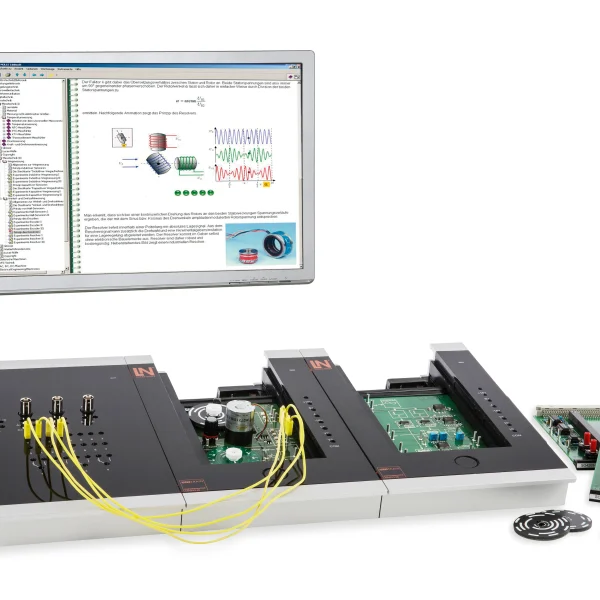
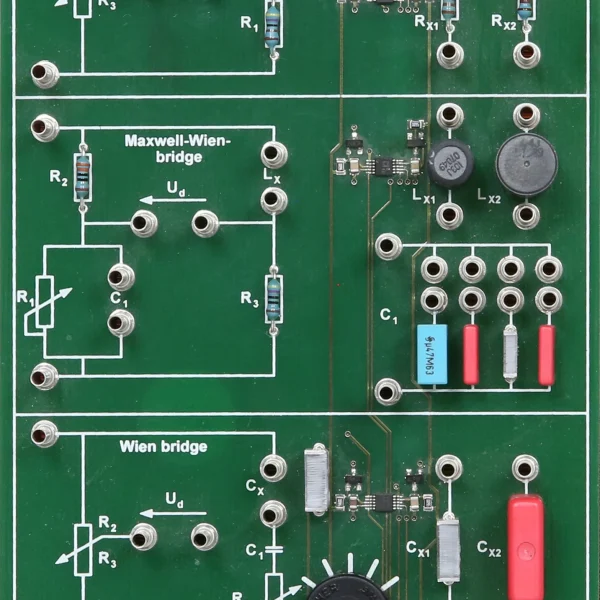
- Current and voltage measurement experiment card (SO4203-5J) — The card carries a diode protection circuit, switchable shunt and series resistors, and R, L and C test objects.
- Experiment card SO4203-5K — The card provides measuring circuits for active, reactive and apparent power, power factor measurement and digital frequency measurement with a 7-segment display.
- Protective circuit and fuse — Integrated diode paths protect the meter movements against overvoltages of up to 24 V and currents of up to 0.7 A.
- Virtual oscilloscope — The instrument displays the waveforms of current, voltage and instantaneous power over time on two channels in X/T mode.
- Waveform generator — The generator produces synthetic and mathematically defined waveforms that can be used to investigate deviations of the meter movements.

From Knowledge Comes Capability.
You guide the learning
Where theory and practice go hand in hand.
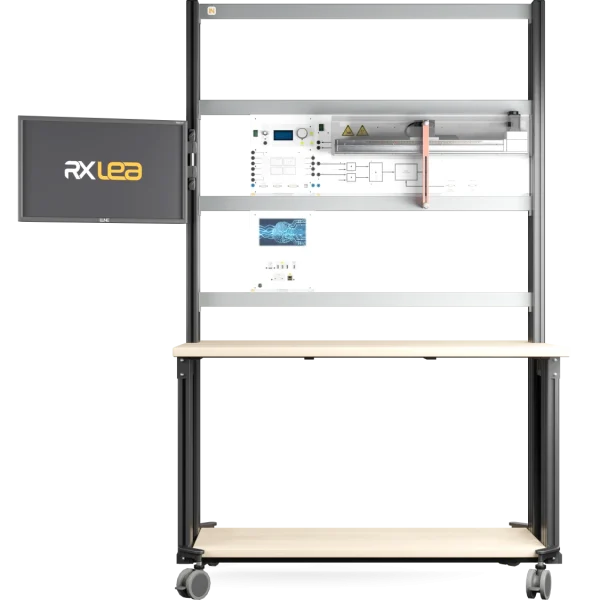
RXLea brings a new way of learning: project-based, hands-on and clearly structured. Learners solve real-world tasks, while instructors save time on preparation. Interactive modules, smart analytics and real hardware create a modern, efficient learning world.
Hands-on and interactive
Animations, interactive tasks and realistic scenarios build a deep understanding. All content is organized into clear learning paths for focused, hands-on learning.
Digital support
3D assembly animations and digital instructions simplify complex procedures, reduce errors and help learners work more independently.
Visual support
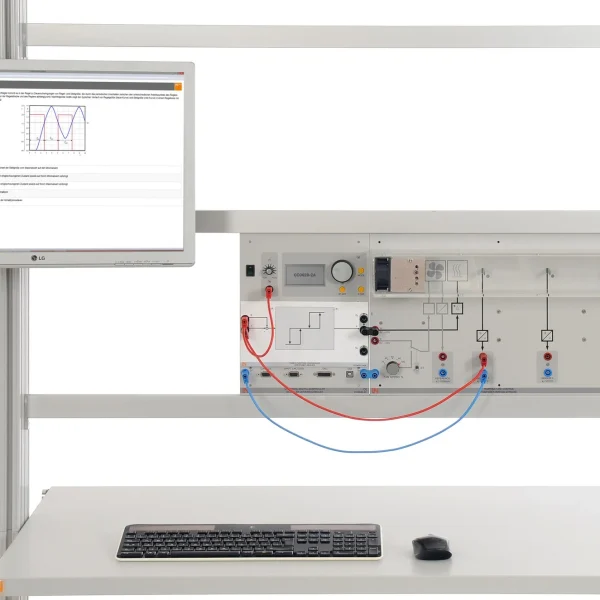
Overview graphics, screenshots and sample animations make the learning world transparent. Photos from the learning packages are also available, including country-specific versions where needed.




Stay ahead in
technical training.
Get the latest training systems, product launches and educational insights, delivered directly to your inbox.