


Measurement Technology: Non-Electric Values T/P/F
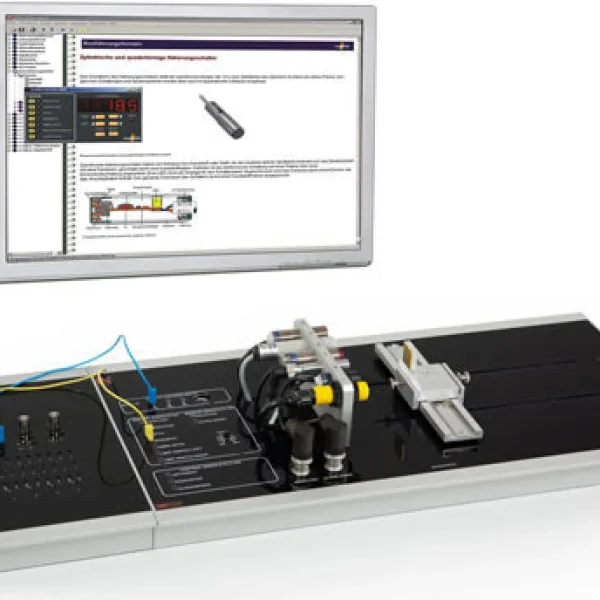
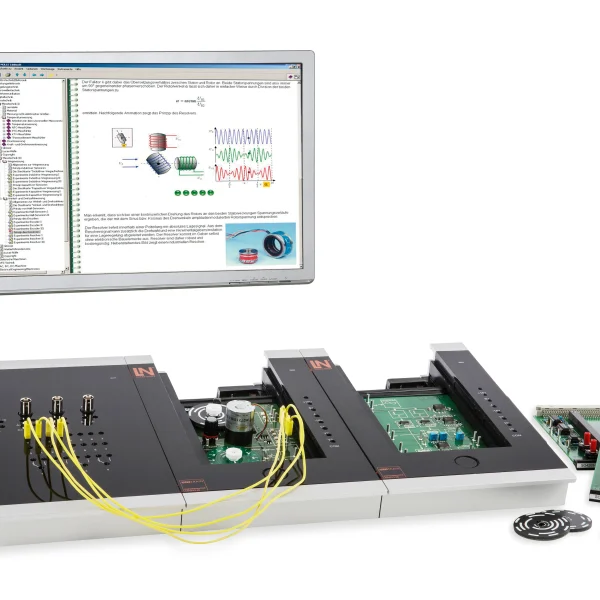
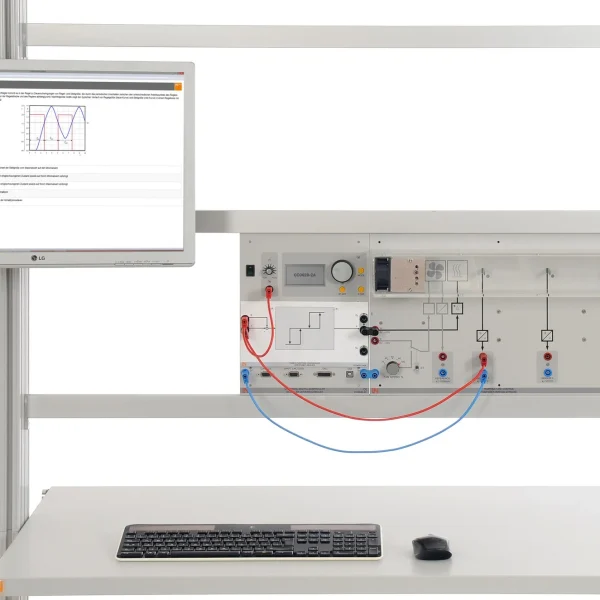
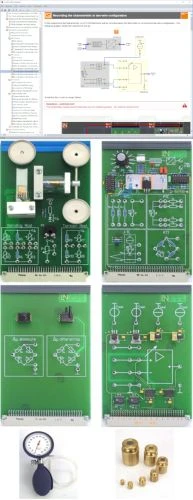
Compact UniTrain training system for industrial sensor technology: learners record the characteristics of NTC, Pt-100 and KTY sensors, a thermocouple, pressure transducers and strain gauges, then amplify and linearize the signals.
- Adjusting the measuring amplifier
- Characterizing NTC thermistors
- Linearizing NTC characteristics
- Comparing Pt-100 connection methods
- Reproducible temperature characteristics up to 80 °C
- Lead compensation with 2-, 3- and 4-wire connections
- Piezoresistive analysis of absolute and differential pressure
- Mechanical force analysis on a strain gauge bending beam
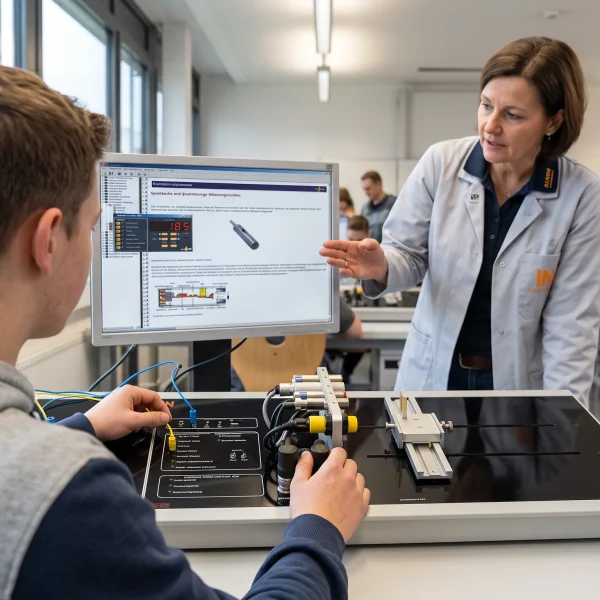
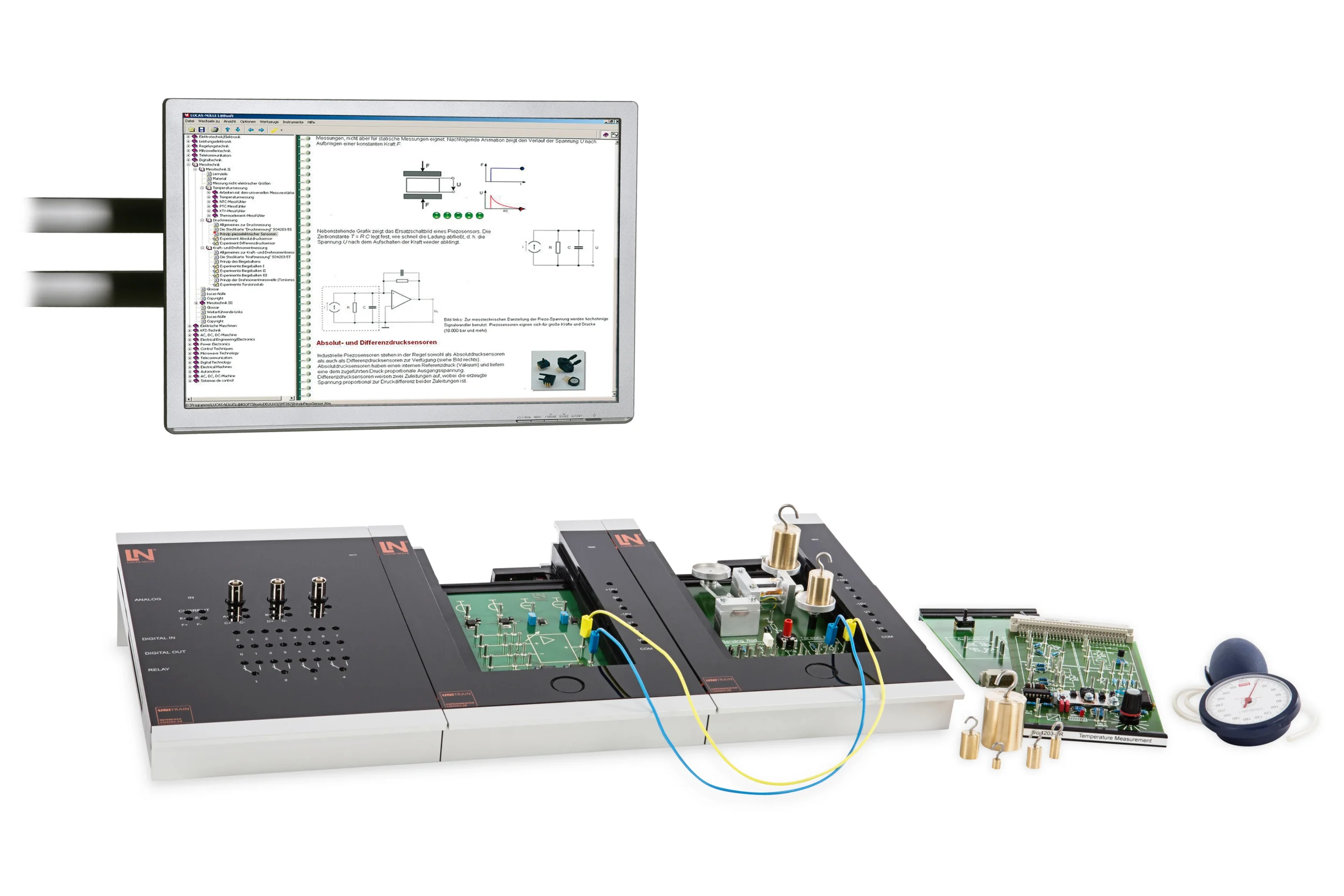
Process monitoring and quality control begin at the point where a physical quantity becomes an electrical signal. Temperature, pressure, force and torque, however, produce small, often non-linear voltages, and lead resistances distort the result further. The UniTrain system makes this chain easy to follow using real sensors. Three experiment cards carry NTC, Pt-100 and KTY sensors and a type J thermocouple, piezoresistive absolute and differential pressure sensors, and a bending beam and torsion bar with strain gauges. Learners adjust the instrumentation amplifier, record characteristics with the virtual XY recorder and compare 2-, 3- and 4-wire connections. By the end, they are able to select sensors, wire them up and evaluate their measurement results.
| Base Product | |
| CO4204-8B | Course Measurement technology 2: Non-electric values T/P/F |
| Measuring Instruments | |
| LM2330 | Multi13S digital multimeter |
| Options | |
| SO4203-2Y | UniTrain storage case for one systemoptional |
| Accessories | |
| CO4203-2A | UniTrain Interface mit virtuellen Instrumenten (Basis VI) |
| CO4203-2J | UniTrain measurement accessories, shunts and connection cables |
| CO4203-2Y | UniTrain storage case for one UniTrain system |
| CO4203-2B | UniTrain Experimenter |
Learning Content in Detail
Adjusting the measuring amplifier
Characterizing NTC thermistors
Linearizing NTC characteristics
Comparing Pt-100 connection methods
Evaluating KTY sensors
Using thermocouples
Measuring absolute and differential pressure
Measuring force on a bending beam
Determining torque on a torsion bar
Features & Applications
- Reproducible temperature characteristics up to 80 °C — An integrated PI controller and a heating transistor with an LM35 reference sensor bring the heating plate to defined temperatures. This allows learners to record characteristics reproducibly and repeat series of measurements.
- Lead compensation with 2-, 3- and 4-wire connections — Learners investigate how parasitic lead resistances in Pt-100 measurements can be completely eliminated by circuit design, comparing the three connection methods side by side.
- Piezoresistive analysis of absolute and differential pressure — Using a hand pump and a calibrated pressure gauge, learners precisely record the characteristics of absolute and differential pressures up to 400 mbar.
- Mechanical force analysis on a strain gauge bending beam — Quarter-, half- and full-bridge circuits are compared on the bending beam. Learners determine the effect of the force and see how sensitivity increases with the bridge configuration.
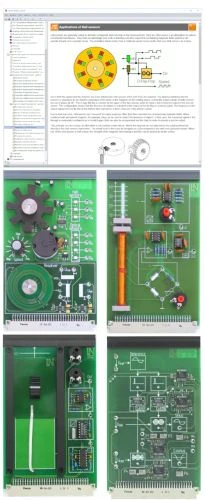
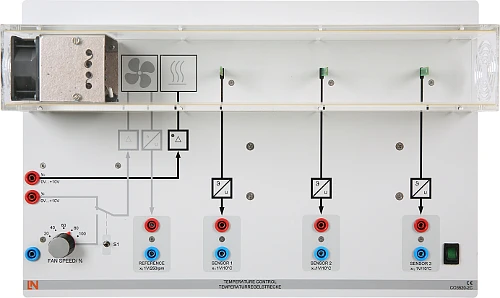
- Temperature measurement experiment card (SO4203-5R) — The card contains NTC, PTC (Pt-100) and KTY sensors and a type J thermocouple, plus a heating plate with an LM35 sensor and switchable lead and linearization resistors.
- Pressure measurement experiment card (SO4203-5S) — An absolute pressure sensor and a differential pressure sensor with integrated resistance measuring bridges capture the pressure signal.
- Force and torque measurement experiment card (SO4203-5T) — A bending beam with four strain gauges allows quarter-, half- and full-bridge configurations. The torsion bar with two strain gauges and a double weighing pan is used for torque measurement.
- Hand pump with pressure gauge — The hand pump generates defined test pressures and displays the applied value, so learners can apply specific pressures to the pressure sensors.
- Virtual oscilloscope — Two channels display the waveforms of current, voltage and instantaneous power over time in X/T mode.
- Waveform generator — The generator produces synthetic and mathematically defined waveforms that can be used to investigate deviations of the meter movements.
- Virtual XY recorder — The recorder automatically records sensor characteristics across voltage and temperature curves and shows non-linearities in real time.

From Knowledge Comes Capability.
You guide the learning
Where theory and practice go hand in hand.
RXLea brings a new way of learning: project-based, hands-on and clearly structured. Learners solve real-world tasks, while instructors save time on preparation. Interactive modules, smart analytics and real hardware create a modern, efficient learning world.
Hands-on and interactive
Animations, interactive tasks and realistic scenarios build a deep understanding. All content is organized into clear learning paths for focused, hands-on learning.
Digital support
3D assembly animations and digital instructions simplify complex procedures, reduce errors and help learners work more independently.
Visual support
Overview graphics, screenshots and sample animations make the learning world transparent. Photos from the learning packages are also available, including country-specific versions where needed.




Stay ahead in
technical training.
Get the latest training systems, product launches and educational insights, delivered directly to your inbox.