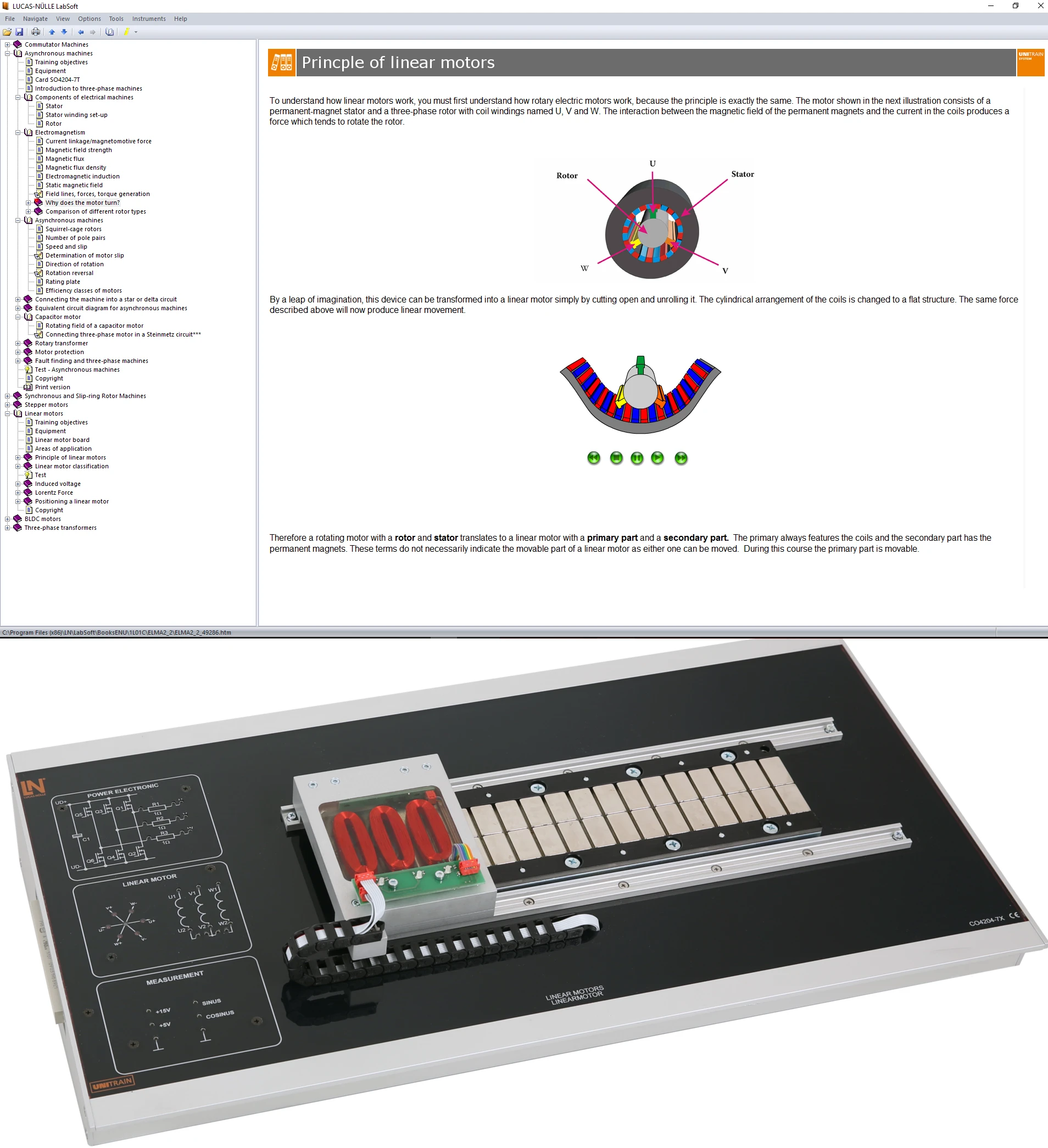



Linear Motors
Linear Motors
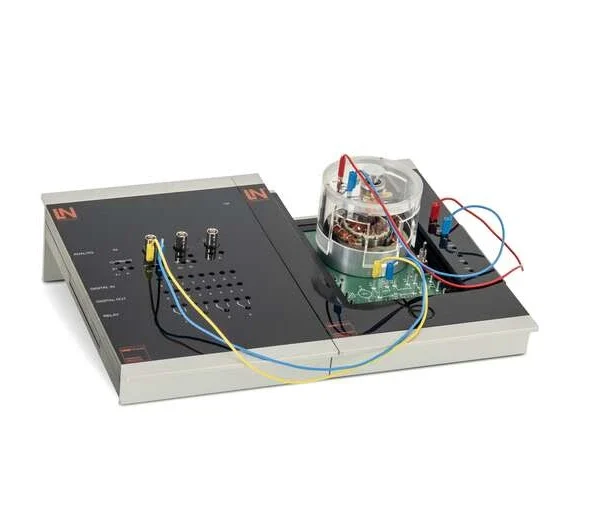
Open UniTrain training system for the ironless linear motor: learners investigate induction and the Lorentz force, determine the motor constant and program travel profiles using virtual instruments.
- Deriving the operating principle
- Explaining how it works in terms of physics
- Classifying designs
- Analyzing operating behavior
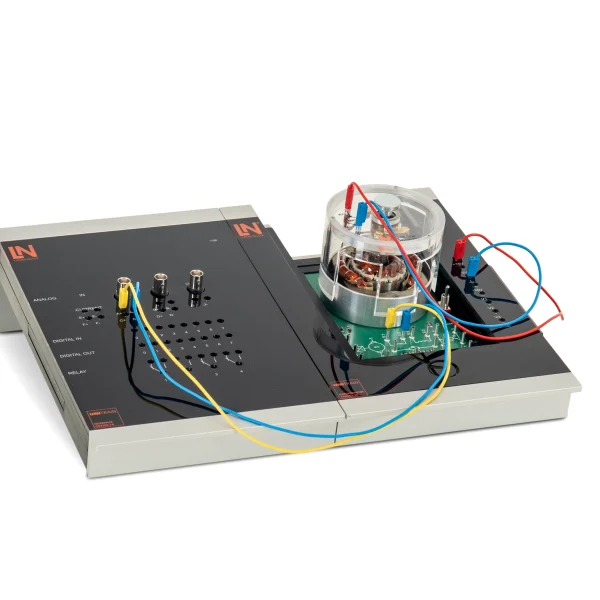
- Open design makes the operating principle visible
- Integrated PWM power output stage
- Position detection with analog Hall sensors
- Experimenting with safety extra-low voltage
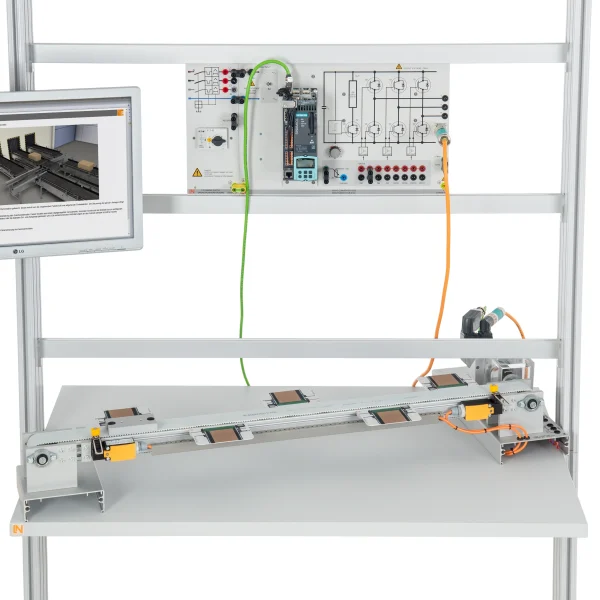
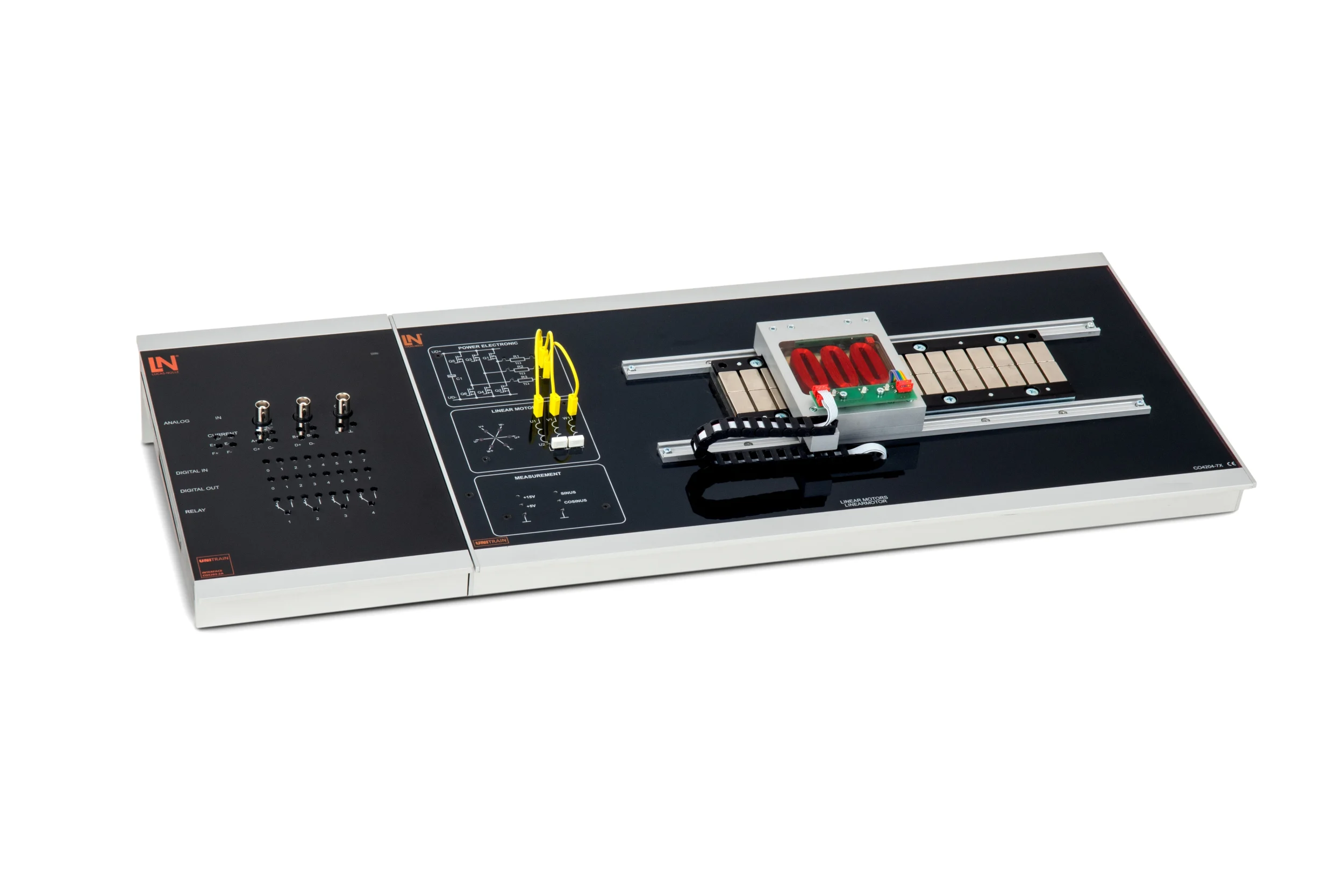
Linear motors generate straight-line motion without a gearbox and are used in automation wherever dynamics and precision count. Anyone maintaining or designing them needs a clear picture of the Lorentz force, induced voltage and position control. The training system reveals exactly these relationships: the experiment board leaves the primary part and magnet track freely accessible, with a travel range of approximately 240 mm. Learners measure the pole pitch, derive the position from the sine and cosine signals of the Hall sensors and control the integrated PWM output stage via virtual instruments. They determine the motor constant, investigate the influence of voltage and frequency on traveling field speed and thrust, and program travel profiles with absolute and relative coordinates.
| Base Product | |
| CO4204-7X | Course Electric Machines 6: Linear motors |
| Accessories | |
| CO4203-2A | UniTrain Interface mit virtuellen Instrumenten (Basis VI) |
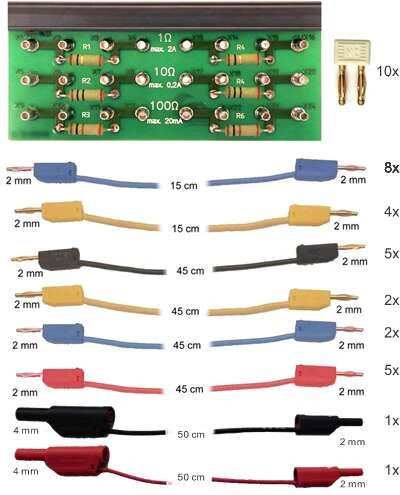
| CO4203-2J | UniTrain measurement accessories, shunts and connection cables |
| CO4203-2Y | UniTrain storage case for one UniTrain system |
| CO4203-2B | UniTrain Experimenter |
Learning Content in Detail
Deriving the operating principle
Explaining how it works in terms of physics
Classifying designs
Analyzing operating behavior
Mastering positioning
Features & Applications
- Open design makes the operating principle visible — All assemblies are exposed. Learners examine the winding arrangement in detail and follow how the primary part interacts with the magnet bed.
- Integrated PWM power output stage — The board carries a microcontroller-controlled PWM output stage for the linear motor. Learners use it to control the motor with virtual instruments on the PC.
- Position detection with analog Hall sensors — Learners compare the sensor principles and use the analog Hall sensors to measure displacement on the running drive.
- Experimenting with safety extra-low voltage — The system works with safety extra-low voltage. Learners wire and measure without risk, and the mechanical forces are also designed so that they pose no danger.
- Ironless linear motor with 240 mm travel — The motor offers a travel range of approximately 240 mm. Learners investigate the cogging-free motion and the dynamics of the primary part.
- Industrial magnet track as secondary part — The secondary part consists of strong permanent magnets. Learners measure the pole pitch and investigate the distribution of the magnetic field.
- Analog Hall sensors for position detection — Two integrated sensors detect the position. From the sine and cosine signals, learners derive the exact position data for the controller.
- LED display of the control vector — Integrated LEDs indicate the current control vector. Learners use them to check visually whether the phase angle of the winding currents is correct.
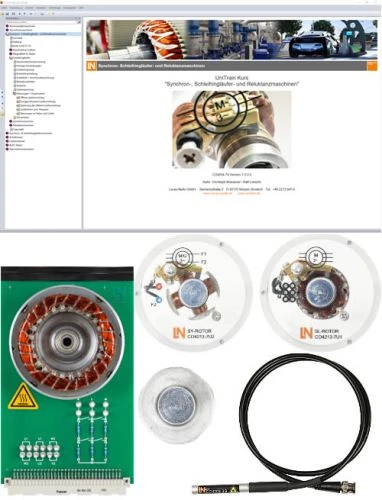
- LabSoft digital learning environment — The software combines theory and practice. Learners read the instructions, answer interactive tests and save their measurement results directly in the user interface.
- Linear Motor Control Unit — Learners set start frequencies and ramps, program travel profiles and optimize the position control graphically on the PC.
- Virtual angle control — Learners specify field vectors manually and investigate how the motor behaves in the steady state at different control angles.

From Knowledge Comes Capability.
You guide the learning
Where theory and practice go hand in hand.
RXLea brings a new way of learning: project-based, hands-on and clearly structured. Learners solve real-world tasks, while instructors save time on preparation. Interactive modules, smart analytics and real hardware create a modern, efficient learning world.
Hands-on and interactive
Animations, interactive tasks and realistic scenarios build a deep understanding. All content is organized into clear learning paths for focused, hands-on learning.
Digital support
3D assembly animations and digital instructions simplify complex procedures, reduce errors and help learners work more independently.
Visual support
Overview graphics, screenshots and sample animations make the learning world transparent. Photos from the learning packages are also available, including country-specific versions where needed.




Stay ahead in
technical training.
Get the latest training systems, product launches and educational insights, delivered directly to your inbox.