


Skip to content

Closed-Loop Liquid Level Control/ Flow-Rate Control

RXLea
Digital projects for hands-on learningInteractive learning content, directly connected to the training system.

Closed-Loop Liquid Level Control/ Flow-Rate Control

IAC12PT

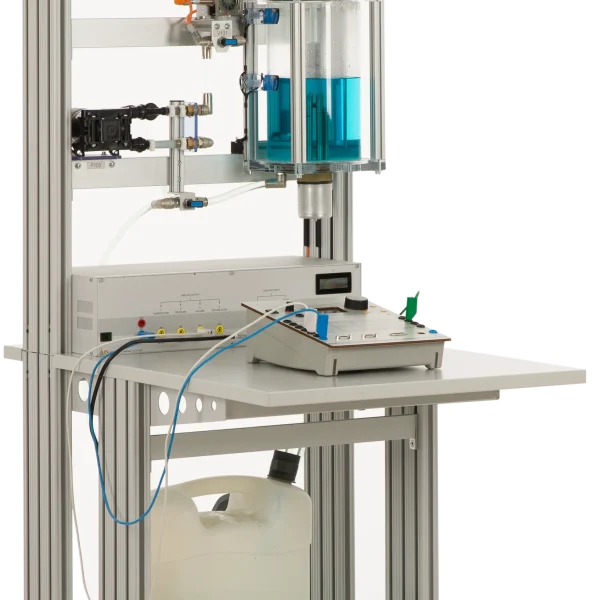
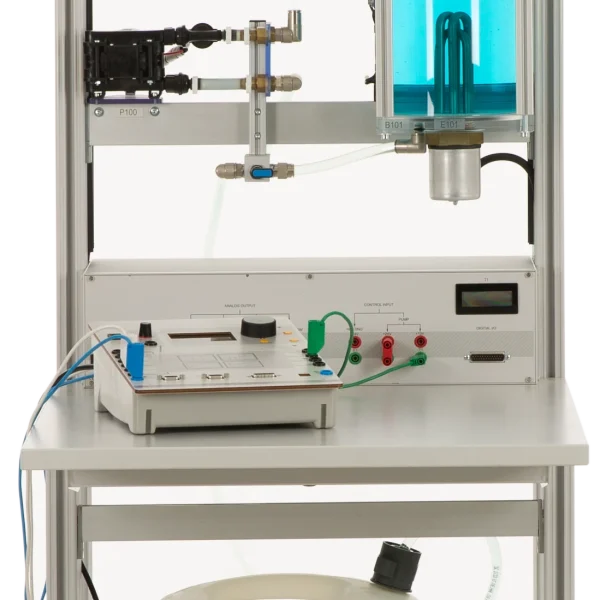
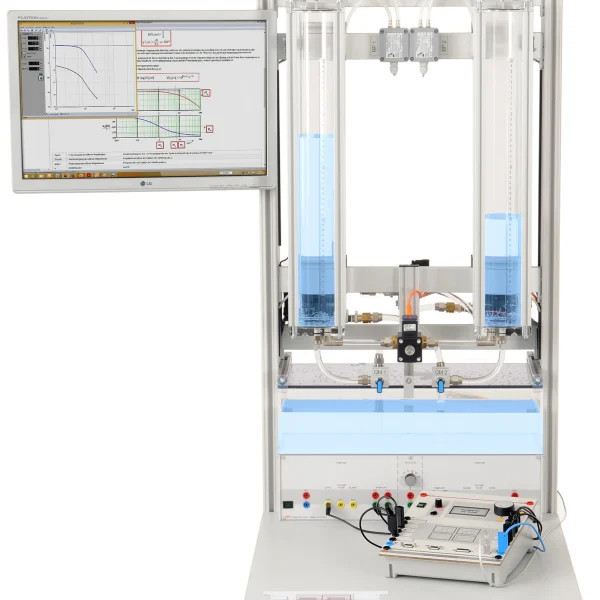
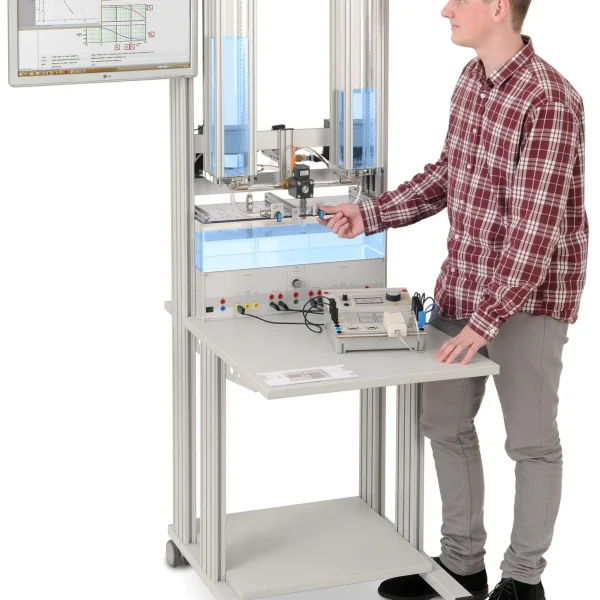
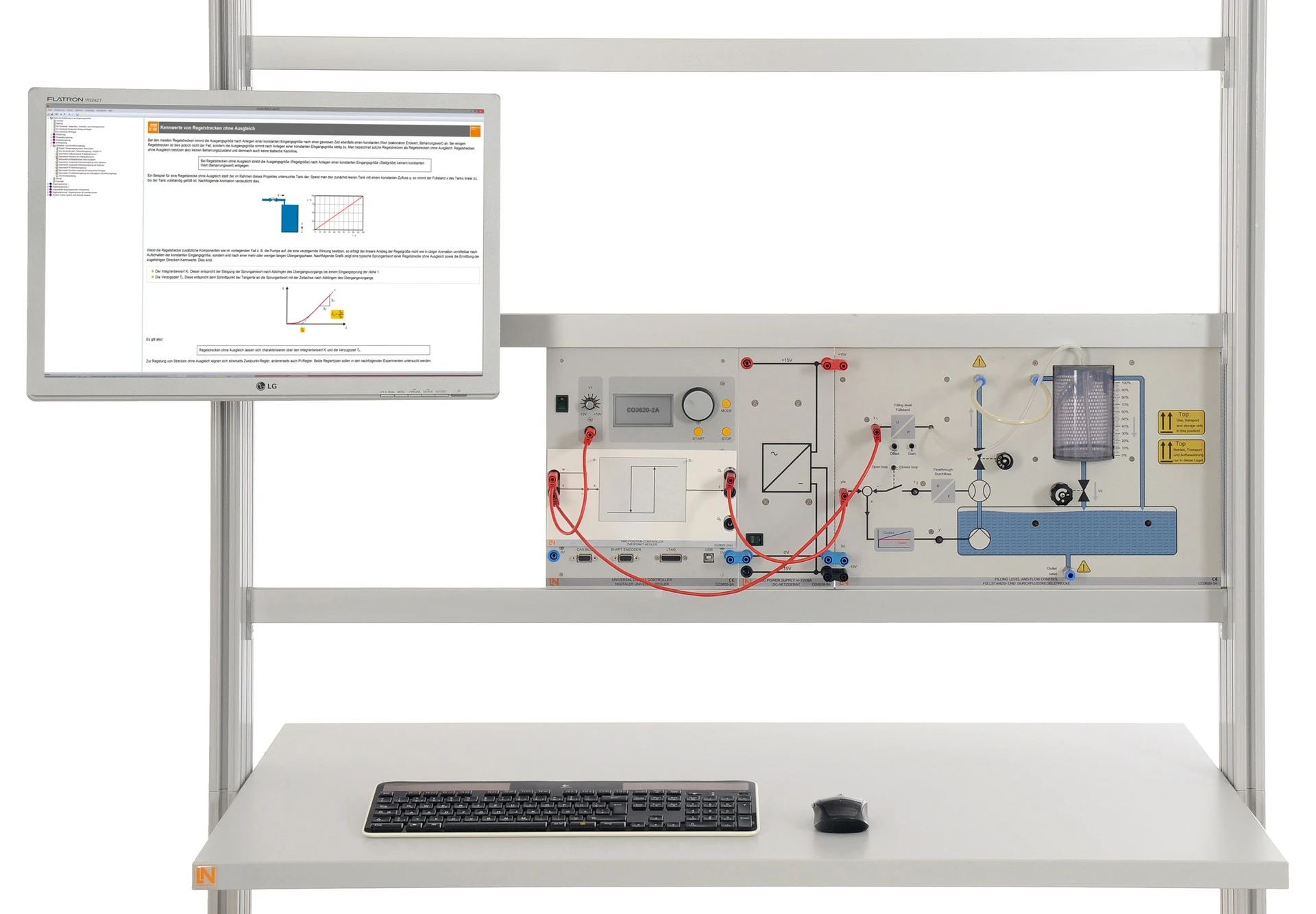
Compact training system for level and flow control with a digital universal controller. Transparent tanks, a pump, a pressure sensor and a flow meter make the control process visible and measurable.

Learning Content
  • Calibrating sensors
  • Recording the sensor characteristic
  • Filtering controlled variables
  • Analyzing the controlled system
KEY FEATURES
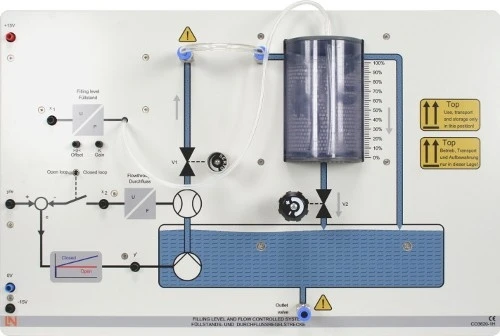
  • Transparent process in clear tanks
  • Integrated flow control
  • Integrated measuring and control instruments
  • Disturbance simulation via throttle valves
Speak with a Product Specialist +1 (757) 808-5696 · sales@lucas-nuelle.com

In the process industry, precise level and flow control safeguards product quality and plant availability. The training system reproduces these processes on a real controlled system: a pump delivers water into transparent tanks, a hydrostatic pressure sensor measures the fill level, and a flow meter provides the secondary controlled variable. Using adjustable throttle valves, learners create static and dynamic load changes and observe what happens in the tank. The digital universal controller and the virtual instruments record step responses and set the controller parameters. By the end, learners are able to identify the controlled system, design continuous and switching controllers and set up cascade control.

Artikel-Nr.MengeBezeichnung
CO3620-1H1Compact level control kit including vessel, tank, pump and sensors
CO3538-8A1DC Power supply, ±15V/6A
LM23301Multi13S digital multimeter
SO2802-3J1Interactive Lab Assistant: Level and flow control kit with digital controller
CO3620-2A1Universal digital controller (DSP)
ST7200-7A1SybaPro experiment trolley, 3-level, 6 sockets, 1250x1970x800mm
ST8010-4T1Monitor holder for flat screen monitor of weight up to 15kg / 33lbs
ST7200-5L1Protection cover for three-level experiment trolleys
ST8010-4G1Keyboard adapter for flat screen monitor holders
ST8008-8N1Protected power distribution for working stations
ST8010-4J1Multiple socket outlet, 6 fold, with illuminated switch
ST8000-6A1Display for the Control Technology equipment
SO5148-1V1Set of safety measurement cables, 4mm (20 leads)
SO5126-3R10Safety connecting plug 4mm with tap (2x), black, 1000V/32A CAT II
SO5126-3V2Safety connecting plug 4mm with tap (2x), blue, 1000V/32A CAT II

Learning Content in Detail

Learners calibrate the sensors, identify the controlled system and design switching, continuous and cascade controllers for level and flow.

Calibrating sensors

Learners adjust the zero point and gain of the hydrostatic level sensor.

Recording the sensor characteristic

Learners determine the linear relationship between the physical fill level and the output voltage.

Filtering controlled variables

Learners smooth noisy measurement signals using an adjustable first-order low-pass filter.

Analyzing the controlled system

Learners determine the integral coefficient and delay time of the dynamic system without self-regulation.

Investigating two-position controllers

Learners compare the oscillation behavior of switching controllers with and without hysteresis.

Designing continuous controllers

Learners parameterize proportional and integral controllers for aperiodic transient responses.

Building a cascade control system

Learners feed the flow rate into the level control loop as an auxiliary controlled variable.

Features & Applications

The tasks are taken from process automation and process engineering and cover system analysis, system identification, and level, flow and cascade control.
  • Transparent process in clear tanks — The tanks give a direct view of the control process. Learners watch the fill level change dynamically and relate it to the measurement curve on screen.
  • Integrated flow control — A subordinate control loop with a flow meter is built in to keep the pump’s delivery rate constant. It can be switched off, so that both operating modes can be compared.
  • Integrated measuring and control instruments — Recording step responses, analyzing dynamic behavior and tuning the PID controller: everything takes place directly on the system.
  • Disturbance simulation via throttle valves — Adjustable valves generate real disturbances. Learners use them to evaluate the dynamic disturbance response of the control loop.
  • Level and flow control system (CO3620-1H) — The compact unit combines a level basin, tank and pump. Learners investigate the physical controlled system on a real model rather than in a simulation.
  • Hydrostatic pressure sensor — The sensor measures the fill level via an immersion tube. Learners calibrate offset and gain until the output signal lies exactly within the 0–10 V range.
  • Adjustable throttle valves — The manual valves change the flow rate in the system, allowing learners to simulate static and dynamic load changes.
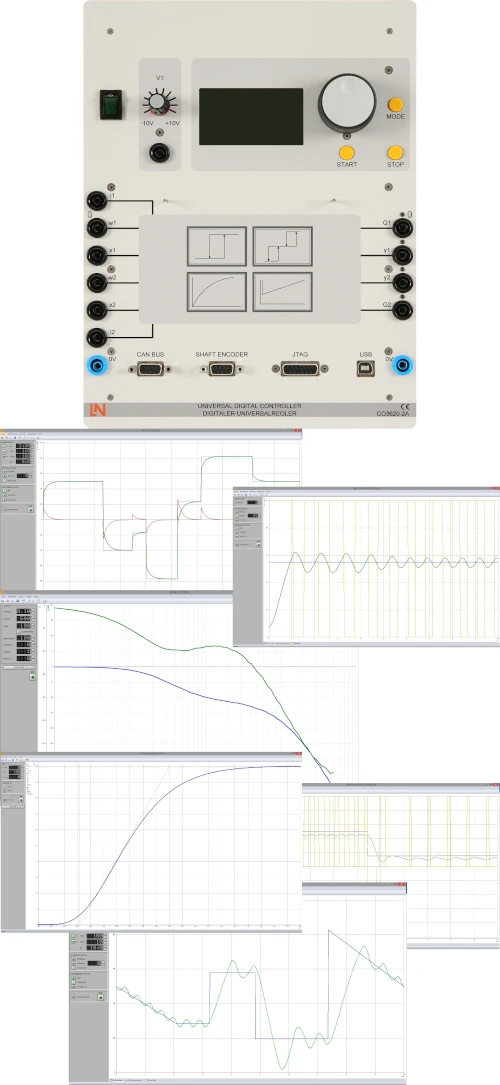
  • Digital universal controller (CO3620-2A) — The universal control unit comes with numerous interfaces for typical controlled systems. Its software functions handle real-time analysis and control.
  • Step response plotter — Learners record the system’s response to an input step in real time and use it to determine the static and dynamic parameters of the controlled system.
  • PID controller — Learners parameterize all controller components interactively and specifically optimize the disturbance and reference response of the connected controlled system.
  • Bode plotter — Amplitude and phase response are displayed. Learners use them to carry out frequency response analysis for systematic controller optimization.
  • Cascaded PID controller — The instrument is used to set up and optimize cascade control made up of level and flow control.
  • System analyzer — The tool compares measured data with models in both the time and the frequency domain, so theory can be applied immediately.
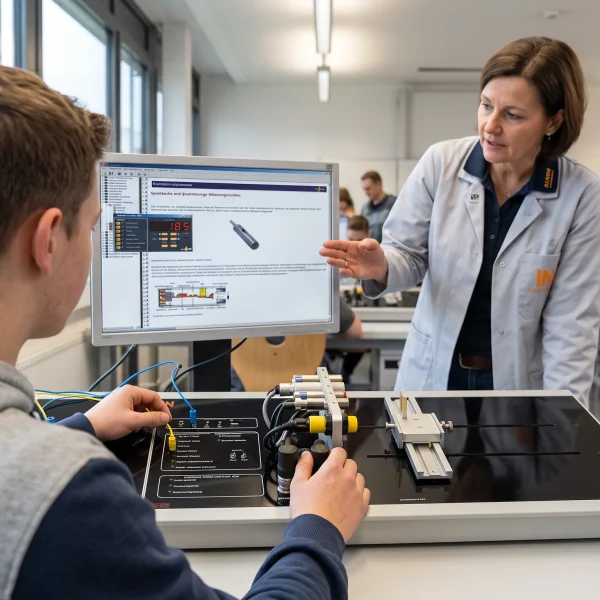
Learners working with RXLea on a tablet at a Lucas-Nuelle training system
RXLea

From Knowledge Comes Capability.

You guide the learning

Where theory and practice go hand in hand.

RXLea brings a new way of learning: project-based, hands-on and clearly structured. Learners solve real-world tasks, while instructors save time on preparation. Interactive modules, smart analytics and real hardware create a modern, efficient learning world.

Hands-on and interactive

Animations, interactive tasks and realistic scenarios build a deep understanding. All content is organized into clear learning paths for focused, hands-on learning.

Digital support

3D assembly animations and digital instructions simplify complex procedures, reduce errors and help learners work more independently.

Visual support

Overview graphics, screenshots and sample animations make the learning world transparent. Photos from the learning packages are also available, including country-specific versions where needed.


Learners using a tablet at an energy training system
RXLea on desktop, laptop and tablet
RXLea Path Creator for building learning journeys
RXLea Navigator showing the learning world
Learn more about RXLea
Newsletter

Stay ahead in
technical training.

Get the latest training systems, product launches and educational insights, delivered directly to your inbox.

Your email address

By subscribing, you agree to our Privacy Policy. You can unsubscribe at any time.

 Please select at least one category before subscribing.
I'm interested in - select all that apply