


Automatically Select and Feed Workpiece Variants Based on Production Orders
Teach the fundamentals of flexible manufacturing. Your students program the order-based selection and separation of different workpiece variants and control material feeding in TIA Portal.
- Understanding variant production
- Evaluating order bits
- Controlling four solenoid valves separately
- Optimizing travel times
- Two magazines for two workpiece types
- Controlling two stoppers and two pawls separately
- Optical monitoring of the fill levels in both shafts
- Controlling the sequence according to order data
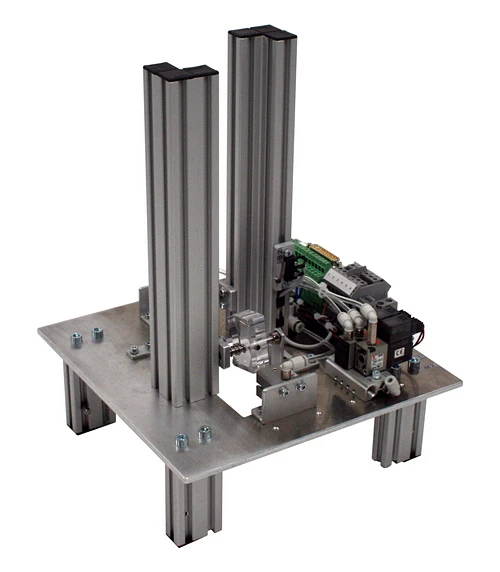
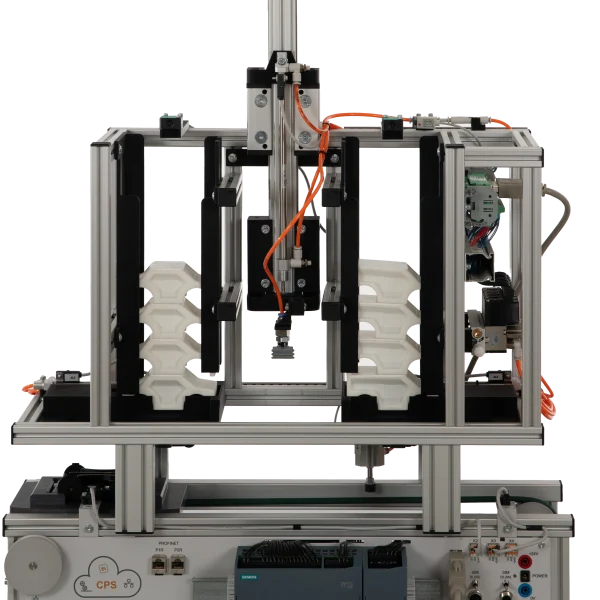
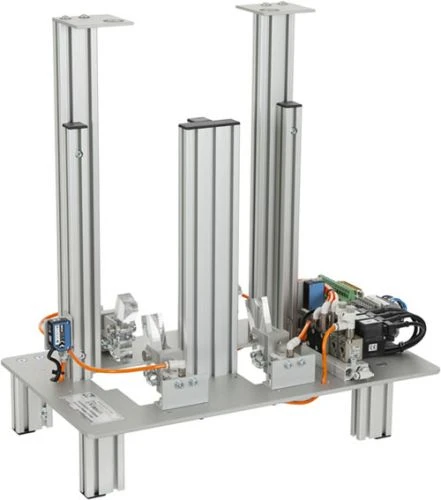
How can different workpiece variants be supplied according to production requirements? This dual mechatronic subsystem helps you teach your students how production orders control material feeding in automated manufacturing. Students program the automatic selection and separation of workpieces and coordinate these operations with material transport.
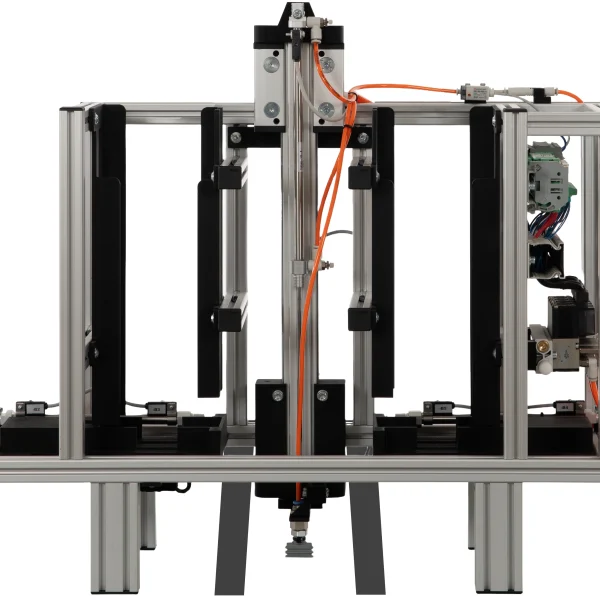
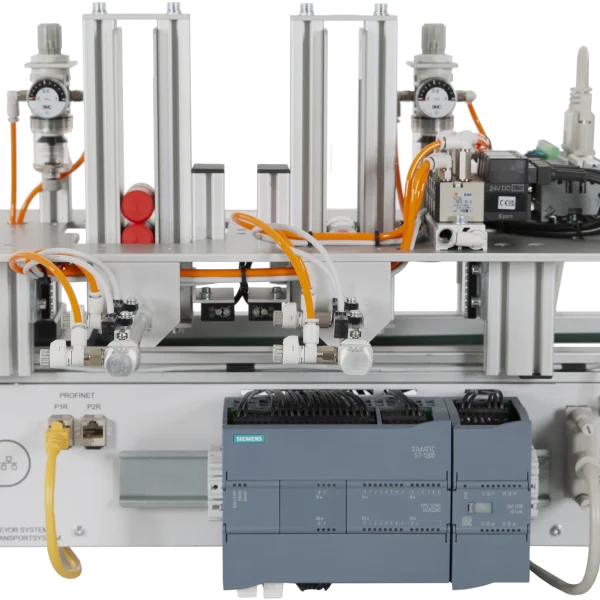
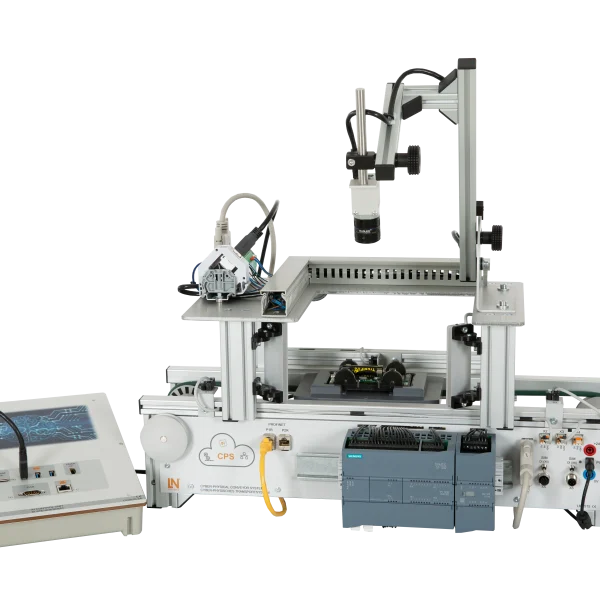
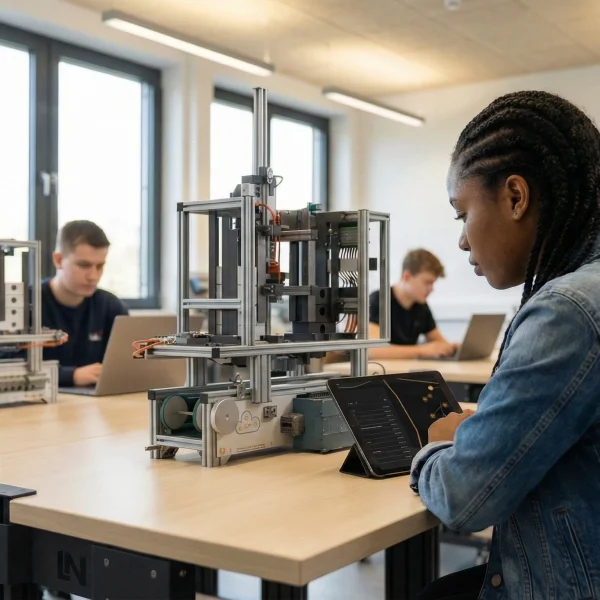
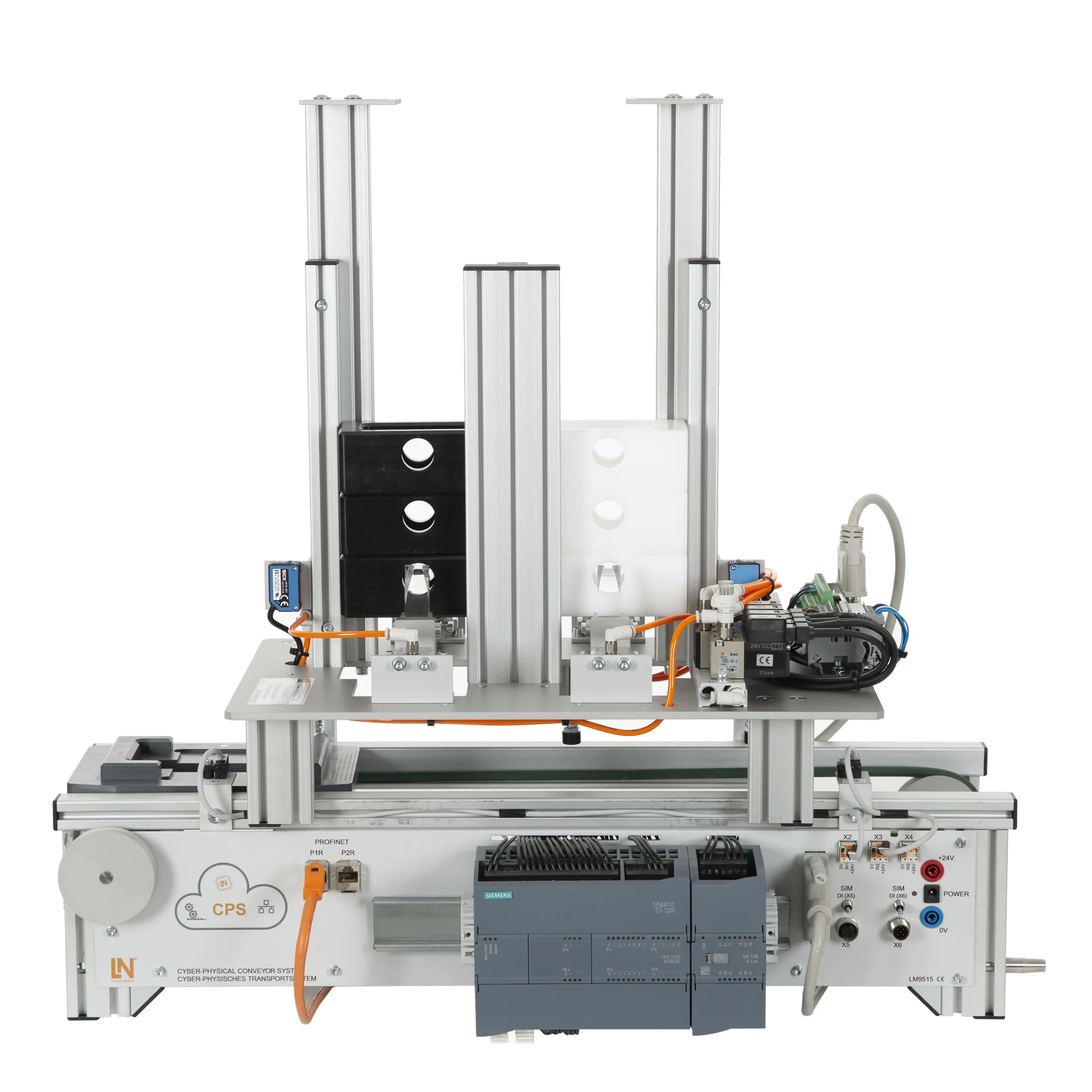
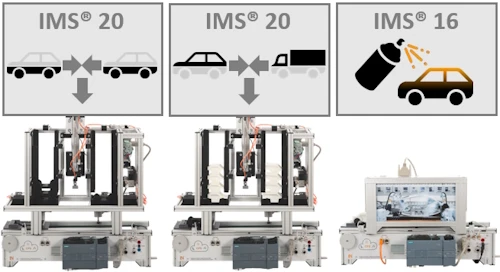
The subsystem integrates into IMS and IMU conveyor lines. Two separate stack magazines hold different lower workpiece sections, such as variants in different colors. Four solenoid valves control two independently operating stoppers and separation mechanisms. Two photoelectric sensors monitor the material levels in each magazine independently.
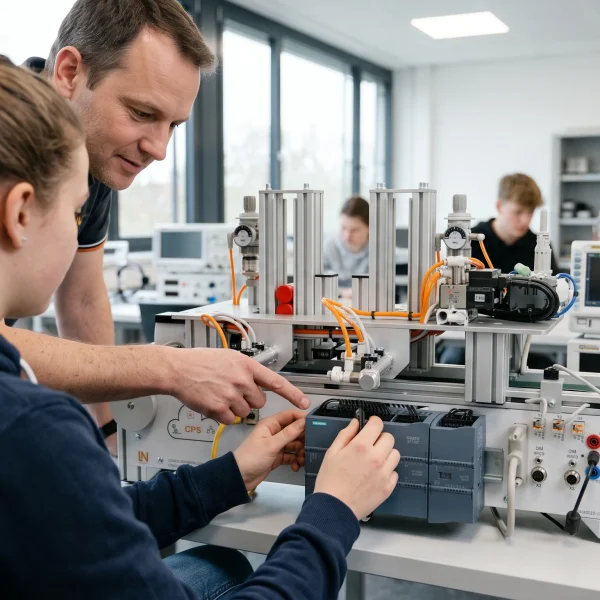
Your students develop a sequence control program in TIA Portal that selects the appropriate magazine based on production order data and releases individual workpieces. They adjust conveyor travel times and reduced-speed phases to match the positions of magazines A and B. Students process order bits, manage the corresponding status flags, and organize reusable program blocks in libraries. This helps you build their understanding of flexible manufacturing processes while developing practical skills in programming and monitoring order-driven material flow.
| Base Product | |
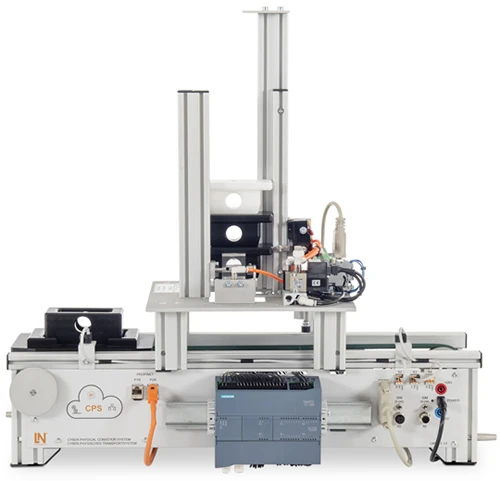
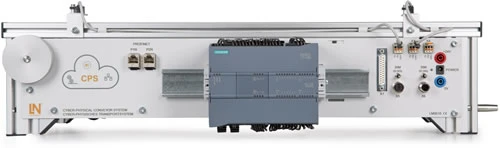
| LM9515 | Cyber physical conveyor system with PLC |
| SO6200-2P | QuickChart IMS 1.5 Cyber-physical conveyor belt system |
| LM9532 | Film, for oscilloscope cameratype LM 7000 |
| LM9672 | DC power supply 24V/5A for IMS conveyor belts |
| LM9645 | Lift model with three storeys |
| LM9066 | Interface cable 25-pin, Sub-D socket / plug 1m |
| SO6200-2Q | QuickChart IMS 3d Mechatronics Separation double station |
| Media | |
| PAT050001C | RXLea Content CIS01IS: Inbetriebnahme eines cyberphysischen Systems |
| SW00001 | Software RX Lea |
| SW00019 | Software LN Installer |
| PAT050002C | RXLea Content CIS01IS: Grundlagen der SPS Programmierung |
| SW00001 | Software RX Lea |
| SW00019 | Software LN Installer |
| PAT050003C | RXLea Content CIS01IS: Geschwindigkeitskontrolle mit PWM |
| SW00001 | Software RX Lea |
| SW00019 | Software LN Installer |
| PAT050004C | RXLea Content CIS01IS: Analogwertverarbeitung in der SPS |
| SW00001 | Software RX Lea |
| SW00019 | Software LN Installer |
| Course | |
| SO2805-5X | Interactive Lab Assistant: Self-commutated converter circuits |
| Accessories | |
| LM9677 | IMS displacement measurement module |
| LM8257 | USB 2.0 Ethernet adapter, 10/100 |
| LM9716 | Set of Allen keys |
| LM9524 | Workpiece, bottom section, white |
| LM9525 | Workpiece, bottom section, black |
| Furniture | |
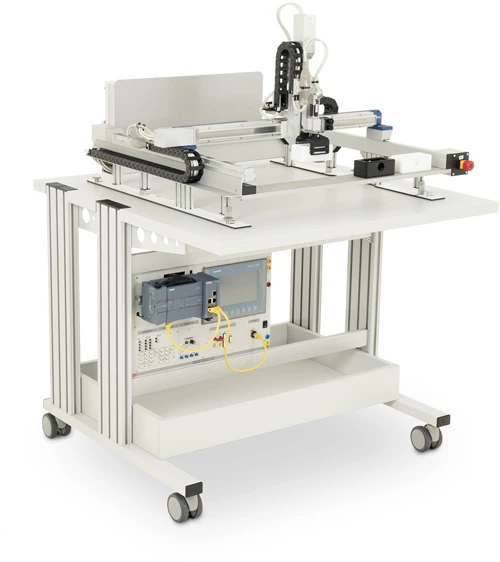
| ST7200-7A | SybaPro experiment trolley, 3-level, 6 sockets, 1250x1970x800mm |
| ST8010-4T | Monitor holder for flat screen monitor of weight up to 15kg / 33lbs |
| ST7200-5L | Protection cover for three-level experiment trolleys |
Learning Content in Detail
Understanding variant production
Evaluating order bits
Controlling four solenoid valves separately
Optimizing travel times
Monitoring several fill levels
Extending function blocks
Using global libraries
Testing process sequences
Features & Applications
- Two magazines for two workpiece types — Two separate magazine shafts allow two different workpiece types to be separated selectively according to the customer order.
- Controlling two stoppers and two pawls separately — Four solenoid valves control two independent stoppers and separating pawls and position the carrier with pinpoint accuracy at shaft A or B.
- Optical monitoring of the fill levels in both shafts — Two light barriers continuously monitor the material reserves in both shafts and report empty magazines to the PLC separately.
- Controlling the sequence according to order data — The controller uses order bits to decide which magazine is approached and unloaded.
- Connection via the system connector — All I/O signals from both shafts are routed centrally to the controller via the 25-pin Sub-D transfer module.
- Two stack magazines, A and B — The magazines hold different workpiece bottom parts, for example black and white housings, enabling variable production.
- Pneumatic separating pawls — Depending on the order selection, two 3/2-way solenoid valves eject the component from magazine 1 or magazine 2.
- Pneumatic stoppers — Two 4/2-way solenoid valves lower the respective stoppers and lock the carrier beneath shaft A or B.
- Cylinder switch: stopper up — The switches detect the upper rest position of both stopper cylinders and safely enable conveyor belt movement.
- Light barriers for the fill level — They optically monitor the minimum fill level in magazines 1 and 2, preventing empty cycles without a workpiece.
- 25-pin transfer module — The module provides the reverse-polarity-protected interface for all four actuator and four sensor signals of the double station.
- Siemens TIA Portal — The engineering environment is used to create variable-based step sequences, data blocks and creep speed parameters.
- Interactive Lab Assistant course SO2805-5X — The interactive learning software guides learners step by step through the programming of double stations and the creation of libraries.

From Knowledge Comes Capability.
You guide the learning
Where theory and practice go hand in hand.
RXLea brings a new way of learning: project-based, hands-on and clearly structured. Learners solve real-world tasks, while instructors save time on preparation. Interactive modules, smart analytics and real hardware create a modern, efficient learning world.
Hands-on and interactive
Animations, interactive tasks and realistic scenarios build a deep understanding. All content is organized into clear learning paths for focused, hands-on learning.
Digital support
3D assembly animations and digital instructions simplify complex procedures, reduce errors and help learners work more independently.
Visual support
Overview graphics, screenshots and sample animations make the learning world transparent. Photos from the learning packages are also available, including country-specific versions where needed.




Stay ahead in
technical training.
Get the latest training systems, product launches and educational insights, delivered directly to your inbox.